Monday, April 22, 2013

Can a Story Change Your Life? - Series Introduction


Is there a kind of story so good - so well executed, so resoundingly right and true - that it makes you a better person for having encountered it?  I think there is.  And I believe that anyone who's ever aspired to become a storyteller - whether as a writer, illustrator, director, or other creator - can attribute that ambition to at least one such story.  A story that bowls you over, that makes you stop and take renewed stock of your life and the world around you.  A story that forces you to reevaluate your goals and outlook.

A story's poignancy isn't determined by its own merits alone.  To work properly, a story has to open up a line of communication between its author and its audience - a kind of one-way dialogue made up entirely of action-and-reaction - the results of which rests most heavily on the audience's reaction.  In order for a story to have the kind of impact that can alter a person's life, it has to resound in the specific ways and areas that resonate with the fixtures of a person's values and beliefs.  That a story crafted by one isolated individual could achieve such a resonance with another person across time and space is itself a minor miracle.  That also means that a story that inspires and impacts one person might not reach another - at least not to the same extent.  A story's effect on an audience member falls on a continuum, and no confluence of author-story-and-audience ever falls on the exact same spot.

This dampens somewhat the usefulness of pointing out specific examples that have made an impact on me.  There's no guarantee that what I've found to be poignant and influential will have the same effect on anyone else.  But I think illustration by example may be the most accessible way to demonstrate how this miraculous conflux of entities - which is, I think, the ultimate goal of any storyteller worth his or her salt - can occur.

Accordingly, this series of posts will introduce the stories that have made this sort of lasting impact on me, and the path that has led me to where I am today.


Monday, April 15, 2013

The Link Between Resume Writing and Fiction Writing

Good writing centers on effective communication.  The central paradox of any work of art - whether a book, a painting, a sculpture, or a motion picture - is that it brings together the minds of its creator and the minds of its audience - sometimes so closely or profoundly that the former influences the latter in a life-altering way - even though the two parties may never meet.  More purpose-driven writing such as memoranda, reports, essays, and even resumes and curricula vitae also hinge on the clear conveyance of the writer's expression - his or her core message - but through avenues that, when successful, lead to direct interaction with intended audiences:  in a resume's case, the job interview.

So what message must a resume convey to secure a spot at the interview table?  The answer depends on another question:  who exactly is the interviewer looking for?  Or, more precisely, what qualities does he or she value above all others for the specific role to be filled?

It boils down to knowing the audience and their expectations.  Just as you'd want to read science fiction or fantasy to be familiar enough with the genre's tropes to know how to use them - and when to break them - before writing professionally for science fiction or fantasy markets, you need to gauge what the employer is looking for in their expected hire, and tailor your resume to match those expectations as closely as possible.

The first step is scrutinizing the job posting.  What will the new hire be responsible for?  What do the education or experience requirements say about the qualities or skills that the employer wants to see?  To what extent can your own experiences and abilities match up with what they're looking for?

At this stage in the process, it may also be wise to consider how closely the job description matches what you're looking for yourself.  If the divide between the lines on your resume and the job description is wide, will you be comfortable bridging that gap if the employer chose you for the job? 


Monday, April 1, 2013

Tools of the Trade: Sketchbooks

In my initial drafts, setting and description often take a back seat to character, action, and dialogue.  Milieu details, therefore, often occupy a prominent spot on my redrafting checklist.  Sometimes you can work out the placement of a scene in your head.  But sometimes the arrangement of a scene requires mapping out to get it just right.  That's where today's Tool of the Trade comes in:  the sketchbook.

Three of my favorite sketchbooks:  Two 9" x 12" Cansons and a B5  Deleter sketchbook mini.

The usefulness of a conducive piece of paper - sized according to your specific needs - comes into play especially when you're dealing with fantastic or sf elements that simply don't exist in the real world.  Case in point:  a short story I've been working on that takes place on an O'Neill-cylinder-style space station.  The climax, which once took place in a deserted industrial district - just like any you'd find on a planet - has moved to a observation "ring" that overlooks the cylinder's interior:


A bare-bones line sketch viewpoint shot of the observation "ring" - which  might eventually be fleshed out into concept art.

I found I couldn't wrap my head around the arrangement and logistics of the climax without drawing out some references first.  In more terrestrial situations, even an overhead two-dimensional map could go a long way to sorting out venues.  In Characters and Viewpoint, Orson Scott Card revealed that the entire premise of Hart's Hope came from a gate-dominated city map he doodled one day.

The more I've worked on my writing and drawing techniques, the more I've found that each sphere of creation resonates with one another; that lessons of technique from one strangely reinforce and point toward lessons in the other.  If nothing else, the deeper you delve into either craft, the more you realize you have left to learn.

Monday, March 25, 2013

Writing Resource: WriteAboutDragons's Brandon Sanderson Lectures


Since his first publication in 2005, Brandon Sanderson has become one of the standout fantasy writers of the 21st century, with bestselling stories of his own - notably the Mistborn trilogy and ongoing Stormlight Archive series - and his role in concluding Robert Jordan's Wheel of Time series.  But beyond his prolific career and worldbuilding prowess, he is also notable as one of the most accessible and open writers in recent memory with regard to his own writing process, and in his ability to share what he has learned with others.  In many ways, his decision to teach the same creative writing course at BYU that he himself took as an undergraduate influenced my resolution to teach several legal writing courses at my alma mater law school - the very same courses that I took as a law student several years ago.

One of the most rewarding aspects of teaching is how the process of teaching others forces you to reexamine your own methods and perceptions, often resulting in new flashes of insight and understanding that not only help you to share what you've learned with others, but also offers a deeper comprehension of the processes underlying your writing, inevitably improving upon it.  Watching Brandon's BYU lectures not only gives you a closer look at the mechanics and practicalities of fiction writing, but also a model of how an expert in a field can effectively share his hard-won knowledge and understanding with others.

This series of 2012 lectures is made available through WriteAboutDragons, which is run by Scott Ashton, a former student of Brandon's who wanted to share the "vast quantities of pure gold that issued forth from Brandon's lips every time he opened his mouth."  Scott will also be sharing lectures from Brandon's 2013 course, with the first video due on June 1st.

Monday, March 18, 2013

Why It's Never Too Late to Start: Retroactive Posts Announcement


Like many others out there, I started this year with a resolution.

And like most of them, I broke it within a week.  (Or a month, depending on how you count it.)

The goal was to update this blog with consistent updates - at least one a month.  What got in the way was a combination of work and after-work - the latter mainly taking the form of teaching at my local law school.  Bottom line is that I got so busy that blogging - and even fiction writing - took a back seat to everything else I had going on, until that monthly milestone had passed me by.

Twice.

Technically, that new year's resolution is broken and gone.  Perhaps the usual response would be, "Oh well, better luck next year."

But I don't want to wait until next year.  I want to get back to where Fictional Matters should be, where it would have been had I managed to update it as I had meant to.

So in addition to updating every week from here on out, I'm going to be instituting a "retroactive posting" project.  That means I'll be adding retroactive posts - one for each week I've missed since January 7th - until I've closed the gap.  It won't unbreak my New Year's resolution, but it'll get FM to where it should be.

It also demonstrates how it's never too late to start working on something you've been meaning to do for a while, regardless of what may have held you back.  The moment you set your mind to it, commit to a plan, and stick to it, is the moment that the false starts no longer matter.  What matters is that you've started.


Monday, March 11, 2013

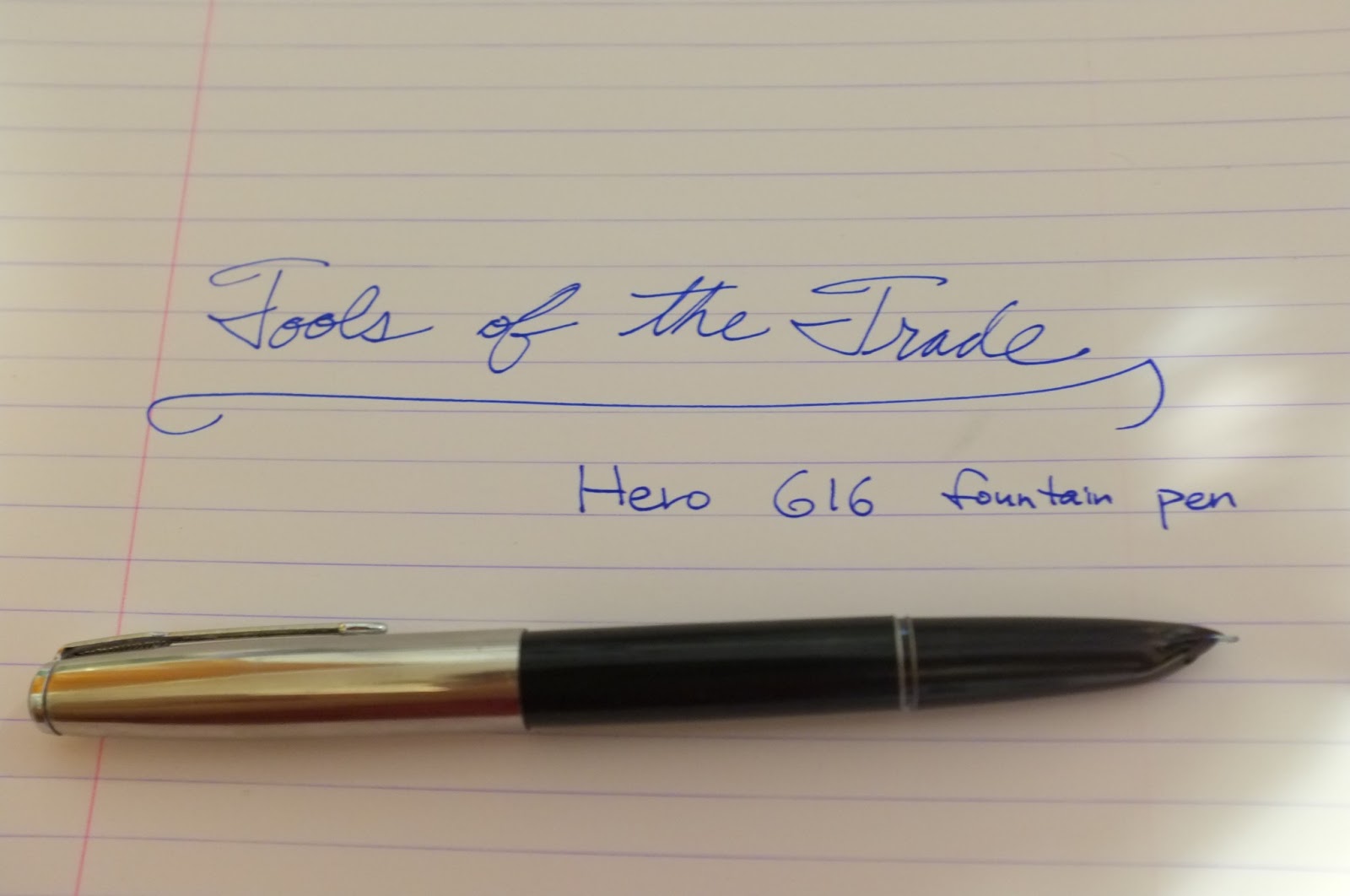
Tools of the Trade: Hero 616 Fountain Pen


Fountain pens have been a lifelong obsession of mine since I first laid hands on a disposable Pilot Varsity over twenty years ago.  The one regret I had from the written portion of my bar exam several years ago was that I was forced to use a heavy-handed ballpoint to write out my answers.  How the examiners managed to decipher my chicken-scratch handwriting well enough to give me a pass remains a mystery to this day.  (Interestingly enough, the very next administration of the exam was the first to allow examinees to type out their essays on a computer loaded with ExamSoft.  Coincidence?  Who knows.)

I've used fountain pens whenever practicable ever since then.  (The usual impracticability occurring wherever carbonless copy paper is used, such as check writing and certain old-school governmental forms.  While a fountain pen could be used in those applications if you exert enough force, I have ballpoints in reserve to save my nibs - and hand - from the unnecessary torture.)   At one point my collection approached a dozen, but like the recent trend with my watch collecting, I've been putting into practice the principle "less is more."  So the Hero 616 is the first fountain pen I've added to the stable in well over two years.  A well-regarded Chinese-made Parker 51 doppelganger, it has several attractive attributes.

The first thing that makes the Hero 616 such an easy addition is its price.  It's readily available on eBay for somewhere between $4-6, shipping often included.  By comparison, the Lamy Safari - commonly regarded as a strong entry-level pen among European models - costs around $20.  The Hero 616 really won't break the bank, and offers solid performance that amounts to a high value-to-cost ratio.  Its affordability also means that you don't have to baby it the way you might a pricier pen costing several hundred (or more) dollars.

That last attribute is the main reason I picked one up:  I've been looking for a good home for my long-neglected bottle of Noodler's Baystate Blue ink.  Baystate Blue is notorious in FP circles for being finicky in use, staining barrels and even laying waste to pen feeds.  Needless to say, it's not the ink you'd want to use in a delicate vintage or exorbitantly priced pen.  So why bother with it at all?  Its vibrant shade of blue brooks no comparison.

The Hero 616 has a reputation as a solid platform for Baystate Blue, and my experience corroborates it.  I've had Baystate Blue clog up a Pilot Prera and Lamy 2000 in the past after only a day or two of disuse.  The Hero 616 is still going strong three weeks down the line.

Monday, February 25, 2013

Writing Resource: Brandon Sanderson's YouTube: Writing Videos


Brandon Sanderson has done for the YouTube age what Harlan Ellison did when he wrote an entire short story in the display window of a department store:  put the usually private act of fiction writing out there for the whole world to spectate.  Through his YouTube channel, in a series of videos that receives an update every week, he is sharing his process in writing an interlude scene from the upcoming second book of The Stormlight Archive series.

I for one have always wanted to peak over the shoulder of a published (and prolific) author to see how they do what so many try to do, but rarely succeed in doing so well.  Brandon makes that wish come true, and the answer is both reassuring and humbling at the same time:  they write their books the same way every person on the planet writes: one letter at a time.  There's no magic method at work here; just hard, consistent work and skill earned from experience.