Showing posts with label Fictional Thought. Show all posts

Monday, May 13, 2013

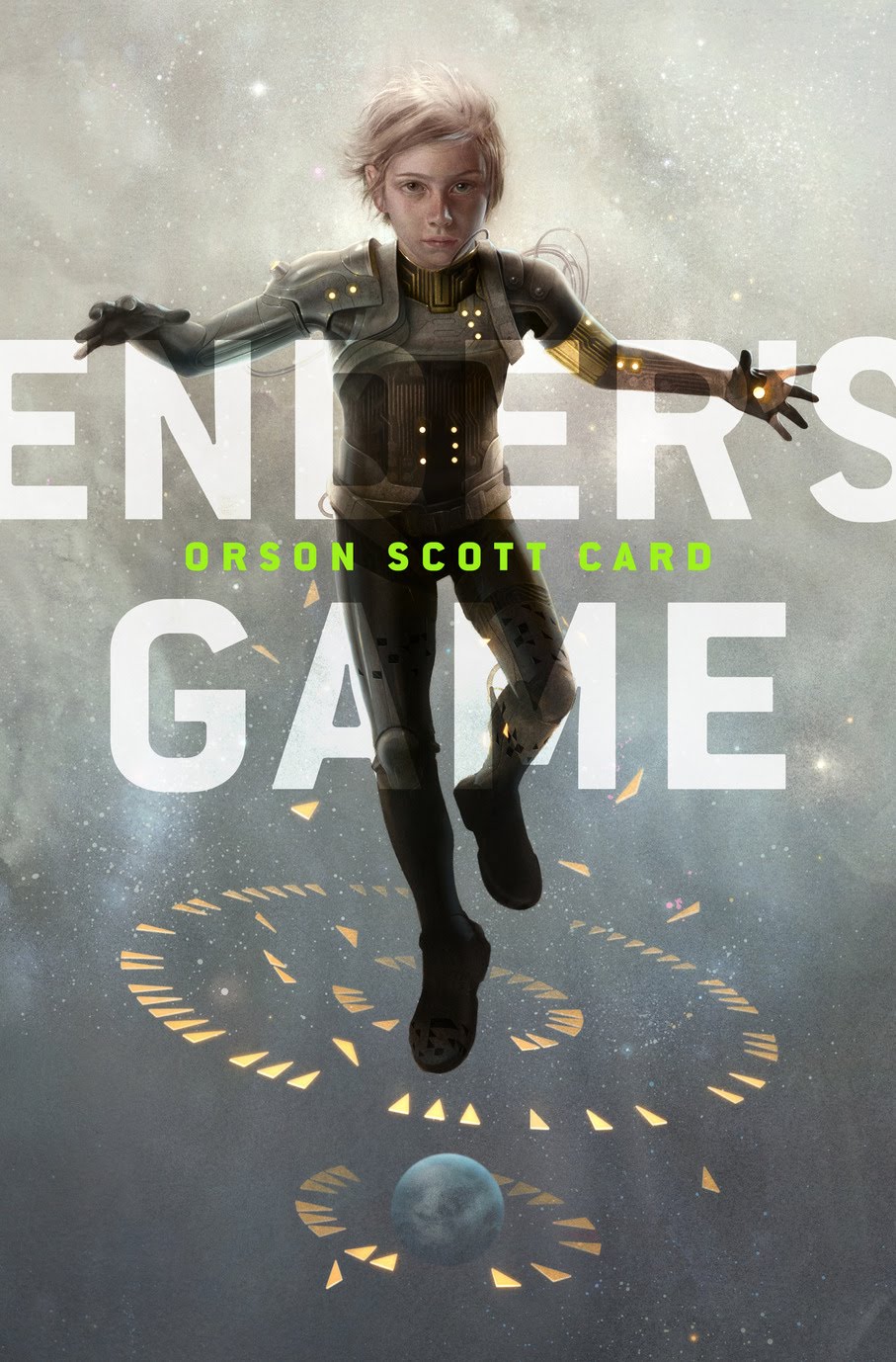
Can a Story Change Your Life? - Ender's Game, by Orson Scott Card


If I had to identify the book that exerted the greatest influence on my decision to become a fiction writer, it would have to be Orson Scott Card's Ender's GameMuch like Alfred Slote's C.O.L.A.R., from last week's Can-a-Story-Change-Your-Life? (or CASCYL for short . . . sounds like "castle?") post, it hit several of my personal interest points:  child geniuses, strategy games, interstellar warfare, and the philosophy of war.  But what gave it such a profound and lasting impact was how it took those elements and interwove them into a deeply compelling story that centered, more than any story I'd come across before it, on character, and really getting you inside his head. 
The science fiction elements, though robust and well-realized on their own, in truth served primarily as tools to allow the reader to delve deeper into the protagonist's mind.  Much like the monitor device introduced in the novel's opening pages allowed Ender's observers to gain a thorough enough understanding of him to make him the linchpin of their war plans, the course of the novel makes the reader so invested in Ender that the wonderfully orchestrated climax scores a direct emotional impact. The reader experiences precisely the same reaction that he does in rippling waves of exhilaration, disbelief, and latent horror - the very essence of catharsis. 

The ironic - perhaps even tragic - truth that Ender comes to realize of his various enemies in the novel resonates with the truth that the reader comes to realize of him:  just as his understanding of them grows to the point where he both comes to love and destroy them in the same bittersweet stroke, the reader's understanding of Ender grows to the point where the reader comes to love him even as he undertakes the very actions that profoundly alter - and, in that way, destroy - the very person the reader has come to know.  Although Ender endures the novel's events, he is, like the mono-mythic hero, changed by the experience, and the boy that the reader has come to know in the course of the novel is lost forever.  The fulfillment of understanding concurs with the echoing ache of that bereavement, and the resulting amalgam of emotion and reason far exceeds the sum of its parts.

This kind of deeply personal connection with story and character is, I think, only possible in the fixed media realm (sorry, film, TV, and anime):  specifically, novels and - I would contend - graphic novels.  Those forms reliance upon written word - which is admittedly on a sliding scale when it comes to graphic novels - are what allow for the in-depth introspection that enables the kinds of character studies that allow you to experience another person's life as your own.  This contention makes me view the upcoming Ender's Game movie with a certain degree of trepidation; divested of the advantages provided by the novel medium and OSC's direct storytelling prowess, will the silver screened story hold up to its written counterpart?  Will what it gains in immediacy of action and bombast of visual and auditory effect make up for what it loses in interior thought and reflection?  The storyteller in my suspects not; the eternal optimist hopes it will.


Monday, April 22, 2013

Can a Story Change Your Life? - Series Introduction


Is there a kind of story so good - so well executed, so resoundingly right and true - that it makes you a better person for having encountered it?  I think there is.  And I believe that anyone who's ever aspired to become a storyteller - whether as a writer, illustrator, director, or other creator - can attribute that ambition to at least one such story.  A story that bowls you over, that makes you stop and take renewed stock of your life and the world around you.  A story that forces you to reevaluate your goals and outlook.

A story's poignancy isn't determined by its own merits alone.  To work properly, a story has to open up a line of communication between its author and its audience - a kind of one-way dialogue made up entirely of action-and-reaction - the results of which rests most heavily on the audience's reaction.  In order for a story to have the kind of impact that can alter a person's life, it has to resound in the specific ways and areas that resonate with the fixtures of a person's values and beliefs.  That a story crafted by one isolated individual could achieve such a resonance with another person across time and space is itself a minor miracle.  That also means that a story that inspires and impacts one person might not reach another - at least not to the same extent.  A story's effect on an audience member falls on a continuum, and no confluence of author-story-and-audience ever falls on the exact same spot.

This dampens somewhat the usefulness of pointing out specific examples that have made an impact on me.  There's no guarantee that what I've found to be poignant and influential will have the same effect on anyone else.  But I think illustration by example may be the most accessible way to demonstrate how this miraculous conflux of entities - which is, I think, the ultimate goal of any storyteller worth his or her salt - can occur.

Accordingly, this series of posts will introduce the stories that have made this sort of lasting impact on me, and the path that has led me to where I am today.


Wednesday, March 23, 2011

Fictional Thought #001: Revisiting the Rejection Pile for Kernels of Truth

It's been more than five years since I last sent out short fiction submissions, and on a whim I decided to look back at those stories.  I've always been a bit embarrassed to look back at my older stories--even the ones that made it to print--so up to this point I've simply let the ones that have collected their full measure of rejections collect dust in my files.  Reading Nei Gaiman's short story collection Fragile Things: Short Fictions and Wonders, however, made me realize that some of those stories might be salvageable.  Or more than that, truly great stories that I had failed, whether through lack of skill or experience, to tell properly. 

I've only managed to work my way through one and a half of them so far, but the mistakes literally leap out at me from the pages.  This could be either a good or bad thing.  Maybe it means I've gotten much better in the last five years; or maybe it means I was crap then, and I'm still crap (though of a slightly lesser magnitude) now.  I'm prepared to reserve judgment on that determination.  But what surprises me is how clearly I can see the gem hidden within each story--a kernel of cathartic truth (for it is truth that the storyteller seeks to share, though every word from his mouth and character on the page is, by the very nature of fiction, a clever lie) that could serve to animate a story, the way the soul can be said to animate a human being--and the sense of excitement I feel at the prospect of nurturing those kernels into a new form, one hopefully more true to them than my previous attempts have been.  In both cases, it's been so long since I'd written the stories that I had completely forgotten about their kernels, so it's almost as if they are care packages that I'd given to myself, more than half a decade ago.