Saturday, October 8, 2011

NaNoWriMo #04: So You've Got A Story Idea - Now What?


This week's post in preparation for NaNoWriMo 2011 looks at the steps that come immediately after you've found an idea for a story.  How do you turn an idea into a story spanning 50,000+ words?
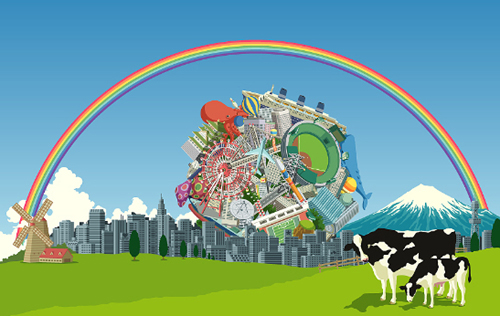


In many ways, developing an idea into a full-fledged story is a lot like the basic gameplay of the Katamari Damacy video game series.  Your idea is like the titular katamari - a magic ball that can adhere to particular things (namely, smaller objects) and add them to its mass, growing each time it picks up a new object.  The things that will stick to your idea are directly related to it, and you can begin in a number of places.

If you're like me, you could begin with characters.  Who is your protagonist?  What is their backstory?  What are their goals and desires?  Who - or what - will oppose them in their quest to fulfill those goals?  As you round out your main character, other characters, plot developments, etc. may pop up in the process.  You can aggregate your original idea with as many characters and as much depth as you like - whatever amount makes you feel comfortable with your prospective cast of dramatis personae.

Other well-known science fiction and fantasy writers are worldbuilders.  Like them, your idea might start with an intriguing premise and develop of the ramifications that it would have on the world in which it exists.  What if special magic users could derive specific abilities from ingesting and "burning" different kinds of metals? This milieu premise is the starting point for Brandon Sanderson's bestselling Mistborn series.  What if a desert landscape covered an entire planet?  Welcome to the starting point for Frank Herbert's Dune.

Or you can take the tiger by the tail and delve right into plot.  What has to happen in order for your idea to work?  What could happen in spite of all that?

This katamari-like process of info aggregation is primarily to get you comfortable and more familiar with the story-wide implications of your idea.  Your cast of characters, milieu, or plot could completely change - and often enough does - once you actually delve into writing your first draft in November, so don't be too concerned about getting every detail right at this point.  Give yourself permission to explore, to make mistakes, fix them, and keep going.  Odds are you'll find yourself having fun along the way.  And here's a secret from a past NaNoWriMoer: once you're comfortable enough with your story idea, the fun you've had in aggregating it is only a pale reflection of the fun you'll experience actually writing the story.  So no matter what, the best is yet to come.


Thursday, October 6, 2011

Fictional Tip: Creating to White Noise

Nearly every creator has stared at a vast expanse of white struggling to set down the first few words of a story or the establishing line work of an image.  Faced with the stark emptiness and contradictorily endless possibilities that a blank page or canvas presents to a creator, the silence of a controlled - but equally empty - work environment can sometimes echo so loudly that it only compounds feelings of apprehension and paralysis.    Perhaps this is why many creators create with music playing in the background; Stephen King, for example, describes his preference for Heavy Metal in his memoir, On Writing.  Another near-cliche has writers seeking out the comforting ensconcement of the coffee shop, where relaxing surrounds and the ambient buzz of fellow patrons can ease the oppression of the creative void.  My preferred white noise of choice is the TV rerun - but only of certain varieties, and all with one prevailing virtue: I've watched them before.

The first variety is cooking shows.  My favorites include Alton Brown's Good Eats (which I've watched so much that I've taken to refer to Mr. Brown as "shisho," the Japanese word for "master"), Iron Chef (original Japanese program), and Jamie Oliver's and Gordon Ramsay's various series.  I've found that they provide a welcome distraction for the small part of my consciousness that serves as the eternal critic, deriding every creative thought that enters my mind and dares to transfer itself onto paper or computer screen.  (That part certain has its uses - namely in the editing and revising phase of creation - but it's a voice that needs to shut up when a work is in its formative stages.)  The acts and instructions of cooking are far enough removed from what I'm writing or drawing in order to keep the programs from being distractions themselves, as my having seen them before keeps me from becoming too consumed with what's happening there to neglect the work I'm creating.

The second variety is specifically Star Trek episodes from The Next Generation, Deep Space Nine, and Voyager.  I've seen these series enough times to usually recall the plot of an episode with no more than the first few seconds of the opening scene, so once again the danger for distraction is minimal.  Also, though the plots and milieu are somewhat uncomplicated compared to the stories I endeavor to tell, they for me also represent a large part of my foundational narrative: that is, I grew up with these stories, so at some elemental level, they possess poetic resonance with the very reasons that drew me toward storytelling in the first place.  

The third variety are Japanese-language programs, primarily documentaries and - predictably - cooking shows.  While this variety may be of best use for those creators who are familiar with more than one language, I find that having a program or even music playing with voice overs or vocals in a different language from the one in which I'm writing helps to keep the white noise from doing more than distracting your inner critic, and perhaps distracting or even interfering with your creative process itself.  I've encountered situations where the white noise I've employed had a detrimental impact on my writing, specifically where I had set my music player to repeat a single song - usually one that I'd only recently discovered and therefore wanted to hear over and over again.  Some of the worst, most melodramatic and pandering drivel I've ever typed resulted from the ad nauseum repetition of an otherwise perfectly good song, and I can't for the life of me explain why it happened.  But not only did the repetition confound my creative efforts, it also tainted my feelings toward the songs themselves, as I'd remember the atrocities against creation they had lead me to commit whenever I heard them after that.  Through this painful trial and error, I learned that repeating a single song while creating is a poisoned well that taints both the one who drinks from it, and the very watertable from which it springs.

So what lessons can we draw from these examples of white noise that worked and those that didn't?  I would say that successful white noise distracts your inner critic, thereby giving your creative mind the clarity it needs to do its job.  But it distracts in such a way that does not pull your attention away from the act of creating, or exert undue influence on the creative process itself.  

Ultimately, what works best for your white noise depends on your own background and preferences, though I would suspect that creating to white noise is a useful technique for anyone who has ever had their inner critic shout down creative ideas that should have been given the chance to make the blank page a little less so.  

What do you think about using white noise while creating, and if you use it, what seems to work best for you?

Tuesday, October 4, 2011

Fictional Review: Working'!! and the Slice-of-Life Genre

Having added an apostrophe to its title (and logo!?), Working'!! is back for its second season.

Continuing the titling convention used in the second season of K-On! (aka "K-On!!" - the two exclamation points referring to it being the second season), Working!! (in which the first season already included the two exclamation points) recently began its second season under the name "Working'!!" - and yes, the apostrophe is not a typo.

Watching the first episode of the new season was a bit of a challenge for me, as the fansub group have upgraded their offerings to 10-bit video encoding, which even the latest version of VLC (1.1.11) does not yet support, displaying only a blank green screen of sadness where the video should be.  Updating to the latest CCCP codec set and opening the video with Media Player Classic fixed the problem for me.  The increase in the depth of visual quality between the encodes I'd in the previous season, which was presumably 8-bit, and this one is striking, as even backgrounds seemed to pop with definition and character:

I'll admit it: the depth of detail on the candy display here made my jaw drop the first time I saw it.

The story picks up pretty much where it left off in the first season, following the employees at the Wagnaria western-style restaurant as their eccentricities complicate their working lives.  If you're new to the series, the second season isn't where you'll want to begin watching, as many of the character's behaviors may seem inexplicable without the benefit of background exposition.  If you're a veteran of season one, though, watching the new season is very much like returning to school - and a familiar lineup of friends and acquaintances - after a summer break.


The girls and surrounds of Wagnaria look especially sharp in 10-bit video.

Working'!! is firmly entrenched in the comedy/slice-of-life genres, the latter of which being, as far as I'm aware, far more prevalent in Japan (particularly in anime/manga form) than it is in the West.  The slice-of-life genre is characterized by light plotting and characterization built on a milieu designed to evoke and emulate everyday life.  From a Western viewpoint of characterization and plot work, the slice-of-life genre should be fairly one-dimensional and uninteresting.  Yet examples of this genre (of which K-On!! is another recent exemplar) have an almost inexplicable allure that draws you into the uncomplicated storyline, and invests you emotionally in the relatively simplistic characters.  Whereas western storylines tend to use conflict and pain to induce audience members to invest emotionally in characters and plot, slice-of-life works focus on evoking a kind of warm appreciation - the Japanese expression, which defies complete translation, is mono no aware, or what I would call the sweet evanescence of all things - for the mundane, the familiar, and the familial.  It flies in the face of everything I learned about fiction writing in college - yet it works.

Part of the reason this entry is a "Fictional Review" as opposed to a "Stories That Matter" review is because  it isn't really the story that matters in slice-of-life works.  And though the characters themselves can gain a strong following, I think it ultimately is the work's ability to evoke a familiar milieu and distill it down to its most essential elements that makes this genre work as a form of storytelling.  K-On!! evokes the high school milieu, in particular the notion of a small group of close friends united by common interests (a common and ubiquitous trope in real life) and intensifies the experience through the rich interactions of members of the KeiOn Bu.  Likewise, Working'!! evokes the milieu of part-time working and the relationships a person builds with his or her coworkers, and magnifies those elements through the potentially over-the-top yet endearing qualities and behaviors of the Wagnaria staff.

Though I'm a dyed-in-the-wool anime and manga otaku, what intrigues me the most about a fictional work like Working'!! is how it shows that there can be more to storytelling than the traditional and overarching motivators of conflict and pain.  While I would still maintain that conflict and pain are essential parts of storytelling, and that even slice-of-life works like Working'!! cannot succeed without including a little bit of both, what this series demonstrates is that there are other methods of building a report with an audience.  It shows that the palette of colors that a fiction creator has at his or her disposal is larger and more varied than depicted by traditional viewpoints.  Mastering the techniques that underlie the slice-of-life genre is essential not just to aspiring anime makers or manga artists, but to anyone looking to deepen the emotional impact of the stories they create.

What do you think of Working'!!, the slice-of-life genre, or the role that familiarity or identification plays in storytelling?  Feel free to voice your thoughts in the comments below.

Saturday, October 1, 2011

NaNoWriMo #03, Fictional Tips #01: Where Story Ideas Come From


Now that I’ve covered the necessary background of what NaNoWriMo is and what you should do to get ready for it, I can back up a few steps and address those who would like to participate, but haven’t really given much thought to writing a novel until now.  One of the most common questions interested parties ask novelists and other storytellers is “Where do you get your ideas?”  It makes sense that this would be one of the first questions people would ask, as almost every story ever written began its life as a simple idea – or, phrased a little bit differently, a “What If.”

It Always Starts With “What If . . . ?”

In many ways, “What If” is the very core of storytelling.  Describing “What Is” doesn’t require a storyteller; all it requires is an attentive observer.  But considering “What If” implies a two-step process of posing a question, and then working out an answer.   Unlike the realm of “What Is,” neither question nor answer actually exists.  Both seem to spring from the storyteller like Athena from Zeus’s forehead: full-grown and ready to wage war.  Which can lead the casual onlooker to wonder: how did she get in there – and where did she find her weapons?

Like everything else in life, ideas for storytelling come from our experiences; they are not, however, limited to them.  A novelist can write about a murderer, or even from the viewpoint of a killer, without having ever taken a life.  Gene Roddenberry could create warp drives and Klingons without ever having to stop and work out whether either of them could actually exist.  In fact, the premise of Star Trek could easily be posed as a “What If” question:

What if advanced technology and an intergalactic egalitarian society allowed humankind to send its best and brightest out to explore the final frontier of outer space?

Or Lord of the Rings:

What if a ring of limitless and corrupting power fell into the hands of a young hobbit?

Or the Harry Potter series:

What if an orphaned boy discovers he is the wizarding world’s best hope against the very dark lord who orphaned him?

In posing what could be, and then attempting to answer that question, we take on the central challenge that storytellers have assumed since time immemorial.  It’s the first step in a journey that, in truth, can never end – and where the journey itself is everything.

Building to Critical Mass

Sometimes, no matter what idea you try to plug into the “What If” rubric, it just seems to fall short.  If that happens – or, more specifically, when – don’t panic.  And don’t simply discard your idea.  Just because it falls short on its own doesn’t mean it’s inherently doomed to failure.  It just needs a little help, and try as we may, we aren’t always up to the task of giving our ideas the help they need, at the very moment they need them. 

And that’s OK, because ideas come to us all the time, if we’re prepared to recognize and retain them.  As long as we hold on to those ideas that seem to fall short, they’ll be on hand when another idea comes – one that is, perhaps, also not quite enough on its own – and can lend us a hand.  As Orson Scott Card notes in his Characters and Viewpoint, combining two distinct ideas can give rise to something completely original and utterly compelling in a way that either idea alone could never achieve.   (His Nebula and Hugo Award-winning novel Speaker for the Dead is a great example, being a combination of the continuing storyline from Ender’s Game and an initially separate idea of a “speaker for the dead.”)


Wednesday, September 28, 2011

NaNoWriMo #02: Gearing Up


Strictly speaking, there isn’t anything you need to do to prepare for NaNoWriMo (though signing up always helps).  Being able to sit yourself down on November 1st and just start writing is one of the virtues of the event.  But if you’re like me, the notion of sitting down to that empty page and blinking cursor is one of the most terrifying (literary) prospects imaginable.  I firmly believe that my success in NaNoWriMo so far has been the preparation I’ve done in advance of November, so if you think that you’ll likely find yourself in the same boat, then October is the month for you to get your head start.

That head start can be anything short of actually writing the novel (remember, that starts at 12:01 a.m. on November 1st!), but here’re a few things I’ve done in the past and will be doing this October.

Outlining Your Story

I’m not really into outlining, but I’ve found that having a framework to guide you through NaNoWriMo is crucial given the time constraint under which you’ll be laboring.   Brainstorm the overall plot arc of your story, write up character dossiers, and even quick outlines of your chapters.  The amount of detail you need is up to you and what works best for your creative process.  Some of us need to have all the ducks in a neat row before writing the first sentence; others just need an idea and an empty canvas on which to chase that idea to its conclusion.  Most of us fall somewhere between those extremes.   Figuring out where you fall and what you’ll need in order to succeed in November is what October is for.

Making a Game Plan

Along with planning the novel itself, planning how you’ll handle the task of writing 50,000 words in 30 days is also important.  50,000 words split into 30 equal pieces is around 1,667 words per day; if you’re very disciplined, you can plan on hitting the 1,667 mark and then calling it a day thirty times, and you’ll be done on time.  If you’re like me, though, you’ll have some days where you’re on such a roll that you’ll want to keep going, and end up with way more than your daily goal, and, inevitably, other days where you’re so busy with life and other exigencies that you can’t even add a comma before the next day arrives. 

To the extent possible, note the days in November when your schedule will be most likely to bottleneck: work deadlines, midterm exams, etc.  Mapping out where you’re most likely to be swamped will help you to figure out how many days you’ll need to designate for catch up – that is, days where you can reasonably set the bar at the 3,000, 4,000, or 5,000 word mark and make up for (or in advance of) days where you won’t get many words in edgewise. 

Locking and Loading

My last “Gearing Up” tip is all about the gear: make sure you have the tools you’ll need to succeed at NaNoWriMo, and check to ensure that they’re all in working order so that you’ll be ready to hit the ground running on November 1st.  Depending on your preferences, you may not need much: a bunch of scratch paper and a writing implement is all you need to start writing, and many NaNoWriMoers do pen their novels by hand.  (Admittedly, though, doing so does make word counting a little bit harder.)  For those who will be doing their writing on a computer, make sure its running smoothly, you have a word processor that you’re comfortable with and can rely on, and, perhaps most important of all, be prepared to back up your files!  It’s best to keep your backup copies on a separate drive, if possible, or even a cloud storage system. 

(My preferred cloud storage is DropBox.  It syncs automatically and is great for keeping files up to date across several computers.  It even has useful apps for iOS and Android that allow you to access and edit your files wherever you go.  If you’d like, you can click on my DropBox affiliate link to sign up for your own account [doing so gives me an extra 250mb of storage space, up to a max of 5gb, and once you’ve set up your own account, every friend you sign up gives you the same bonus as well].)

The point of locking and loading is to iron out any potential technical issues that might stand in the way of completing your 50k.

Monday, September 26, 2011

NaNoWriMo #01: What It Is And Why It Matters


NaNoWriMo stands for “National Novel Writing Month.”  It began in 1999, when founder Chris Baty and a group of likeminded friends first pegged November as the month in question and set out to pen 50,000 words in 30 days.  As of last year, according to the NaNoWriMo.org website, over 200,000 people participated and 30,000 of them completed 50,000 or more words by the November 30th deadline.  

What Are the Rules?

The rules are simple.  You write your first word on November 1st and keep going until November 30th.  If you reach the 50,000-word mark by the 30th (on average, that’s 1,667 words per day), then congratulations: you’re a NaNoWriMo winner! 

Why Participate?

The NaNoWriMo website (which is due for an exciting renovation this year) provides tools for your to track your word count progress and communicate with and derive support from other participants through its forums.  Local groups often organize “Write-Ins” where they arrange to meet in a particular venue to toil on their word counts together. 

Beyond these tools and activities, your participation in NaNoWriMo is really up to you.  There’s no editor (outside of your own head!) who will draw red lines through your sentences and make you rewrite them.  No webmaster or forum moderator is going to look through what you’ve written and make sure that the words you enter into the word counter tell a story or even make sense.  What NaNoWriMo gives you is an excuse to sit down and write, a month-long clarity of purpose in which you can breathe life into that story idea that has been niggling at the back of your brain for years on end.  It gives you permission to suck in your first attempt — as Hemingway said (and is proven true often enough), “The first draft of anything is shit” — so that you have room to complete it, and, eventually, go back and refine it.  It allows you to prove to the harshest critic of all — yourself — that the novel you’ve always said you’d write can, in fact, be written.  And it allows you to do all this in an environment where thousands of others are toiling in unison with you, all across the globe.

My First NaNoWrimo Experience

My participation in NaNoWriMo began in November 2008, but I first learned of it in the previous year from Mur Lafferty’s I Should Be Writing podcast.   NaNoWriMo wasn’t my first experience writing a novel, as I had taken a year between college and law school — what I think of as my “fourth year” of college, as AP credits allowed me to graduate in three — to write the rough draft of my first novel, which I’ll be referring to here on Fictional Matters as Book One.  But that 130,000+ word draft had literally taken me the whole year to complete, so the notion of writing 50,000 words in 30 days was still daunting to me.   On top of all of that, I was in my third year of law school, which meant I was juggling classes and responsibilities as a law review editor, teaching assistant, and research assistant at the same time.  It really didn’t make much sense to add NaNoWriMo to my already overflowing plate, but I did it anyway. 

I did it as a way to show myself and my friends how serious I was about fiction writing.  I did it in order to prove that I still could write fiction after two and a half years of law school and legal writing.  I also did it as a partial rebellion against the traditional lawyer’s career path that I had placed myself on, an acknowledgement that I’d be taking a different direction after graduation.  It was grueling, but I succeeded in reaching 50,000 at the eleventh hour on November 30th, and doing it in a way that didn’t compromise my law school responsibilities, as I managed to ace that semester’s classes (and AmJuring, or getting the top grade in, my favorite class and area of law, Intellectual Property Law).

And I've been at it every year since then.

Your (Future) NaNoWriMo Experience(s)

If you’ve ever thought about writing a novel but talked yourself out of it, got too busy or simply never got around to it, you owe it to yourself (and your unwritten novel) to give it a try.   The experience will open your eyes to the possibilities of what you can achieve if you only dedicate the necessary time and resources.  Even if you’ve never contemplated writing a novel before, if you’re in for a potentially life-changing experience or just looking to try something new, give it a go.  If you decide to, there’s a whole community of others who will try along with you, and support you in this journey.  For my part, I’ll be following up with advice on how to get prepared for NaNoWriMo, some tools and strategies, and a day-by-day update of my own progress this November.

Sunday, September 25, 2011

A Fictional Manifesto


This post marks a turning point for the Fictional Matters blog, as from here on it will feature new posts on no less than a weekly basis.  After setting up this blog in March 2011, I took some time to determine the kinds of content that I will be able to provide, as well as what its readers would want to see.  

The following series are a glimpse of what you can expect to see here in the coming days:

  • Fictional Tips: These posts will feature techniques, advice, and thoughts on the craft of storytelling.  For most of my storytelling life, my medium of choice has been the written word, in the form of novel-length and short fiction.  I have also dabbled in illustrations, and have been working for the past month on my first fan-made comic, or doujinshi.  As a result, most practical tips will center on writing and drawing.  Tips focusing on the philosophy of the craft, however, will draw examples and inspiration from all media.
  • Fictional Tools: This series will feature the tools of the storyteller's trade, such as pens, pencils, keyboards, drawing tablets, and creation-oriented software and apps.  
  • Stories That Matter: These posts will review stories that constitute special achievements in the storytelling art and, in doing so, offer a great experience for storytellers and non-storytellers alike.  
  • National Novel Writing Month (NaNoWriMo) Series: These posts will highlight what NaNoWriMo is, what steps you can take to get ready for it, and tips for succeeding in writing 50,000+ words of story in 30 days.  I've been a NaNoWriMo participant — and, knock on wood, perennial "winner" — since 2008, when I succeeding in reaching 50,000 words by November 30th despite being in the midst of the fall semester of my third year of law school.  This special series will feature posts on a more frequent basis in the months of October, leading up to NaNoWriMo, and November, the actual Novel Writing Month in question.