Thursday, November 20, 2014

File Backups and Writing on the Cloud

Image courtesy Comindware.

As a young writer, I was obsessed with portable word processing.  Being able to work on *.doc files while on the go was why I continued to use Palm OS devices long after their heyday, and why to this day I'm still fascinated by anachronistic devices like the sadly now-discontinued Alphasmart series.  But one of the main reasons these technological milestones of yesteryear are no longer around is because they've been rendered obsolete, like so many other devices that serve specific purposes, by the ubiquity of the do-everything smartphone.

If you have a smartphone, you can write, edit, and process documents with 99% of the functionality of the full-blown MS Office suite.  Even redlined edits and footnotes, long ignored by mobile document apps and the bane of editors and legal professionals everywhere, can be utilized by apps like Textmaker Mobile.  And if you pair that smartphone with cloud storage accounts like Dropbox (my personal favorite), Google Drive, OneDrive, or iCloud, you don't need to fumble with USB cables or worry about keeping up-to-date between desktop and mobile versions of your files.  Every time you save your changes, they'll be uploaded to every device linked to your cloud account.  You can spend your 30-minute train commute drafting a new scene on your phone, and that draft will be waiting for you on your computer when you get home.

All that being said, storing your writing on the cloud isn't foolproof.  If you accidentally delete a file, you might find it also deleted from every other linked device.  (There are steps to recover those files, but it's not always a sure thing.)  Sometimes the cloud service itself may make a mistake and delete your files by accident.  The bottom line is, relying solely on cloud storage is still putting all of your eggs in one basket, no matter how widely distributed that basket's contents may be.

So while your writing should be on the cloud - and is made incalculably easier to pass from smartphone to desktop to laptop and back again because of it - it shouldn't only be here.  As with all vital data, it should be backed up in more than one way.

The main backup I like to use is on removable media, like flash drives or USB-powered hard drives.  I use the free version of SyncBack to copy the contents of my Dropbox to removable media on a weekly basis.  I'd suggest that mission critical files be backed up on at least two redundant mediums, so that if one fails, there's still a backup available.

The final backup is one I use rarely, but is a great fail-safe for those who don't completely trust their work to electronic devices (and, so long as most digital storage media remain susceptible to strong magnetic fields, perhaps none of us should):  paper copies.  I try to avoid printing things out whenever possible, but for your most important pieces of work, keeping hard, physical copies ensure that, short of a cataclysm that divests you of nearly everything you possess, you'll never lose the fruits of your labor.  

Thursday, November 6, 2014

How to Organize Your Story Notes: Should You Keep a Story Bible?

In some ways, organizing story notes has never been easier.  The old mainstays of pen and paper are available in innumerable forms, including regular sheets of paper, post-it notes, notecards, notebooks, steno pads, and journals.  A personal favorite of mine is a pocket-sized Moleskine (or Moleskine-style notebook), which is the perfect size for portability, usability, and cutting and pasting in snippets or printed sheets.

But as far as portability and ease of use goes, it's hard to top free cloud services like Google Keep - which essentially functions as an ever expanding wall of digital post-it notes.  Or if you prefer keeping a tighter rein on your digital files, organizing your doc or txt files in a Dropbox folder will make them accessible anywhere with an internet connection.  Bottom line is, if you carry a smartphone, you already have everything you need to keep as many or as few story notes as you want.

So the question becomes:  Should you?

The simple answer is that it depends.

At the very least, as a writer, you should have some record-keeping method on hand at all times just in case inspiration should strike.  A random story idea, a sudden moment of clarity regarding a particular difficult plot point, a unique insight - these vital notions are prone to effervescence like an elaborate dream upon waking.  Having Google Keep only a few taps away on your smartphone means that you can record these ideas within moments of their occurrence, but I'll admit to also carrying a low-tech contingency for the odd situations where batteries run out or internet connections fail: a Midori Memorandum card in my wallet, which is the size of a credit card and contains 31 tracing-paper-thin sheets:


And a PicoPen on my keychain:


That's about as unobtrusive a note taking setup as you can get, though writers with larger hands may find the PicoPen a little small, in which case a Fisher Space Pen may be an ideal if slightly less convenient upgrade.


I've taken random story notes while riding a train in Tokyo, walking the streets in Portland and flying high above the clouds over Hawaii.  Your brain is always working on problems even when your attention is elsewhere, so learning to be receptive to those sudden strikes of inspiration - and having the means to record those revelations while they're still coherent enough to be recollected - can save you hours of staring blankly at a blinking cursor, trying to reconstruct your thoughts after the fact.

Friday, October 3, 2014

Fictional Matters Returns this November!

Fictional Matters will return with fortnightly blog posts every other Thursday starting November 6th.

There's a whole lot on the way, so stay tuned!

Monday, July 1, 2013

Can a Story Change Your Life? - Resonance Squared: Pluto, by Naoki Urasawa (x Osamu Tezuka)


Astroboy, or Tetsuwan Atomu, will always occupy a special place in my heart.  It was - albeit in English-dubbed version - my introduction to the world of anime.  It's a story that centers around a human-like robot - which, as mentioned in my C.O.L.A.R. CASCYL review, tends to put me in a story's corner from the get go.  It is the most famous work by the effective "Godfather" of anime and manga, Osamu Tezuka.  Nevertheless, though it occasionally touches on bigger, more philosophical issues, it's a series aimed primarily at children, and adopts a certain degree of silliness that, though endearing, erodes its inherent verisimilitude.  That really isn't a fair critique for a work that purposefully doesn't take itself too seriously, but from a storyteller's point of view, it's a valid one.  Nevertheless, Astroboy's popularity and longevity have given it a certain degree of global cultural status.  To the extent that it has, it was perhaps inevitable that it would be remade or re-imagined in the way that other dramatic icons have been in recent years, from Sherlock Holmes to Batman.  Not all such reworkings add something to the original, but as Stephen Moffat and Christopher Nolan has demonstrated, when they do work, people sit up and take notice.

The characters of Pluto juxtaposed with their original Astroboy counterparts.

As mentioned in the last CASCYL post, Naoki Urasawa blew me away with his Monster series despite having none of my favorite tropes to lean on.  His achievement was one of masterful storytelling, particularly his use of the trappings and devices of the mystery genre.  In Pluto, he takes that tool set and applies it to one of the most popular story arcs from the Astroboy canon - "The Strongest Robot in the World" arc - resulting in a murder mystery story that builds on his success in Monster and yet also manages to pay respectful homage to the original Astroboy source material, all the while elevating the story to something truly paradigm shifting.  The story's revelations and resolution echo long after its ending.

Like Monster, Urasawa's deft pacing compelled me to read all of Pluto in one sitting.  (Though since it clocks in at eight volumes to Monster's eighteen, it thankfully didn't take me a nearly unbroken 24-hour span to finish it.)  But for me, the most poignant aspect of the series came after I'd set down the final volume.  What ensued was a sleepless night of quiet introspection, and resulted the following morning/afternoon with the very rough first cut of a short story that is intended for submission to the Writers of the Future competition.  While other stories have influenced and inspired my own work, never have I experienced such a rush of creative urgency as I did after finishing Pluto.  I was physically and emotionally exhausted, but was compelled to channel what I felt into story form before allowing myself to rest.

(The fact that I also went without eating for that period also spurred on the change in diet and lifestyle that allowed me to shed nearly seventy pounds.  So in this case, it could be said that reading Pluto literally changed my life - or at least set me down a path that would lead to a profound lifestyle change.)


Monday, June 24, 2013

Can A Story Change Your Life? - The Meaning of Plot-Driven: Naoki Urasawa's Monster


If I remember correctly, a suggestive piece of fan art by the Canadian artist kurot was what originally put Monster on my radar.


There's a certain amount of irony to that fact, as I have to admit, on the basis of the series's own art alone, I probably would never have taken the time to look into it.  That isn't to say that it's poorly drawn; the art is perfectly serviceable and suits the story's demands.  It just doesn't call out from the page like a siren's song, compelling readers' (or at least my) attention the way, say, the precision of Takeshi Obata's work in Hikaru no Go or the sheer moeness of the character designs in Kamichu! or K-On!  Worse yet, Monster touches on none of the usual genres or tropes that populate my fictional wheelhouse.  Yet, like all well-crafted mysteries, it poses a single question at the onset that is tantalizing enough to compel its reader to continuing reading long enough for several other questions to be posed - and in turn, their answers sought.  Before long, the unsuspecting reader is barreling headlong through a 18-volume manga series, unable to turn away until the final scene is unveiled and the mysteries - at least the ones that will be answered outright - are revealed.

In my case, I read through all eighteen volumes in a roughly 24-hour period, only pausing to attend classes.  (I believe this was the Fall or Winter quarter my third undergraduate year.)  The urgency with which I consumed each volume was only matched by the profound impact that another Urasawa work would leave on me, several years later.

Aside from being an exemplar of the mystery genre - albeit in graphic form - Monster also reveals how the plotwork and devices of the genre can be used to enhance the plot of non-mystery stories.  The layering of questions-to-be-answered is, at its core, the most elemental function of plot in storytelling; the audience's interest in "what happens next" is the true impetus behind any story.  That interest can be fostered and maintained with beautiful turns of phrase, depth of character or milieu, or fascinating ideas and events, but the most fundamental motivator is the question that cries out for an answer.  When a story's opening compels its audience to read on, it has posed its preliminary question - "what's going on here?" - with enough intrigue to drive readers past its unfamiliar trappings.  And, by the time that the preliminary question is answered, and the audience knows enough about the characters, milieu, and events to understand the story's context, other questions have been raised which demand their own answers:  "Who is she, really?"  "What will they do?"  "Why is all of this happening?"  And "How will it all be resolved - if it's to be resolved at all?"

Posing and answering these questions involves striking a delicate balance.  Too many questions too quickly threatens to overwhelm an audience, while too few or answering them too linearly may cause them to lose interest.  There is also a danger in tying up every loose end so that the story's resolution is so neat and tidy as to feel manufactured, yet too many loose ends left undone makes things seem unfinished, ill-plotted, or simply leave the audience unsatisfied.  It takes a masterful hand to handle plot in a way that satisfies but never seems  contrived.  Monster helped me to realize that much of the trick lies in carefully managing the seed-and-answer cycle of the questions that your fiction raises along the way.

Monday, June 17, 2013

Can a Story Change Your Life? - The Bevelled Edge of Love and Hatred: The Tamir Triad, by Lynn Flewelling


I came across Lynn Flewelling's The Bone Doll's Twin - the first book in the trilogy that she calls The Tamir Triad, succeeded by Hidden Warrior and The Oracle's Queen - via, as those who've been reading this series may be able to guess, a review by OSC.  (While his recent works seem to fall short of the stories he churned out in the 1980s - Ender's Shadow being the exception - and I share very little common ground with his political polemics, the man remains a consummate judge of the storytelling art.)  He would later call it "[p]erhaps the deepest psychological novel I've ever read - the fantasy makes the unconscious issues real.  Gorgeous but dark," and "brilliantly original and moving. This story still haunts me, months after reading the books. . . . Th[ese] book[s] drag[] you through so much emotionally painful territory that you're almost relieved when it's done and you can escape to your safe regular life."

I agree completely with his sentiments, yet for me, The Tamir Triad isn't so much about darkness and pain as it is about their polar opposite.  It's about love in all of its forms - family, fellowship, and romance - how fine a line separates it from hatred, and how subtly a relationship can shift from one mode - or extreme - to another.

The premise of the books is certainly a dark one, and Flewelling doesn't shy away from exploring the grimmer corners of her own magic systems and milieu, or the human psyche in general.  What struck me the most - and haunted me long after reading the books - wasn't the dire acts and situations, but how genuine, wholesome, and loving the relationships that evolved between the principal characters were.  Despite the complications that necessarily flow from the opening acts of The Bone Doll's Twin, the main character's childhood is one surrounded by caring and invested adults, and - as the story progresses - is further enriched by peers of approximate age, and a best friendship that comes to define the course of the story later arcs.  True, many elements of those relationships serve to deepen the plot and punctuate the conflicts; in fact, the corruption of the familial love between the protagonist and a cousin into an embittered hatred between rivals to a throne is perhaps the most tragic aspect of the entire story.  But it is also the strength of those bonds that serve to carry the protagonist and other principal characters through the pain the plot demands - and to emerge from it whole.

While right and wrong may never blur together, there are no one-dimensionally good or evil characters.  Even the nastiest actors are given touch points of understanding, so that even if the reader cannot condone their actions and roots for their downfall, he or she at least can perceive where they are coming from - or, perhaps, where they went wrong.

As with most stories worth discovering, The Tamir Triad leaves you not only with a greater and satisfying understanding of the characters and events in its own world, but imparts greater insight into your own.

Monday, June 10, 2013

Writing Resource: Writing Excuses Podcast

Well into its eight "season," Writing Excuses is a podcast put together by storytellers Brandon Sanderson, Howard Tayler, Dan Wells, and Mary Robinette Kowal.  Each episode is approximately "Fifteen minutes long, because you're in a hurry, and we're not that smart," and chock full of first-hand advice and wisdom from three successful creative content creators.  Not only does Writing Excuses offer guidance to the scores of one-day creators out there, but it also provides a peak at the perspectives and parlance of those who have made successful inroads into the industry.  Of particular interest to those who - like me - have trouble confining their storytelling to shorter lengths, is a recent episode that focuses on short stories, with Kowal deservedly serving as the topic expert.

Monday, June 3, 2013

Can a Story Change Your Life? - The Value of Suffering: Traitor, by Matthew Stover


This CASCYL installment differs from previous posts in that it looks at a book that's a part of a larger franchise, arguably one of the largest:  the Star Wars Extended Universe.  Traitor, by Matthew (Woodring) Stover was one of the middle novels of the sweeping New Jedi Order series, and as such can be easily overlooked, especially by those who don't have the time or inclination to read up on the other books in the series to get the necessary context.  I would argue, however, that Stover's treatment of the primary characters in Traitor is deep and intimate enough to allow it to work as a stand-alone novel on that basis alone.  While knowledge of the Star Wars and New Jedi Order-specific milieu is certainly helpful, it's not actually required.  The story is about novel's the main character - Jacen Solo, one of the twin offspring of Han Solo and Leia Organa Solo - and his personal growth amidst his captivity by the enemy Yuuzhan Vong forces and the enigmatic Vergere.  But it also contains a send off for another Extended Universe character that is perhaps one of the finest scenes ever rendered in a Star Wars novel.

The hallmark theme of Traitor, as well as what makes it such a gripping and intimate tale, despite its popular sci-fi trappings, is suffering.  Stover explores the theme both directly and philosophically, and the way in which the characters respond to it - and are shaped by it - is an inherently cathartic process that fulfills the primary purpose of fiction:  to give the reader experience of having lived an entirely different life, and the chance to allow the lessons and discoveries made in the process to reshape and redefine his or her own life.

For me, though, Traitor drove home a principle of storytelling that I had never fully accepted:  the notion that  suffering is the force that propels all action in a story.  At some fundamental level I understood this premise; but given the ham-fisted treatment that many YA novels I'd encountered had given it, I'd relegated the direct relationship between suffering and plot development as the province of lesser, more brutal storytellers.  I surmised the link had to be more attenuated to have the nuance and impact that it ought to have; that the whispered word resonates stronger than the utterance shouted at the top of your lungs.  Stover proved that a storyteller can - and, in fact, should - be as brutal toward his characters as the story itself dictates, so long as that brutality is given proper meaning.  Unfettered brutality is a spectacle, an event to be abhorred but never understood.  It happens because it happens.  Brutality coupled with purpose is far more incisive, because the shock-and-awe of the event is inextricably tied to the motives and goals behind it - both those of the in-story tormentor, tormentee, and the overarching daemon who pulls their strings:  the author.  The lesser storyteller uses suffering as a cudgel to bludgeon the plot along the path he or she wants it to travel; the master uses it as a scalpel, concealing the cut marks of his or her work beneath the fully realized actions and motivations of the characters themselves.  The characters' purposes overshadow the author's on stage, to the point where the puppet strings are all but invisible.  The reader thereby is forced not only to witness the spectacle, but understand why it has come to be - why, in many ways, the natures of the attendant characters made it so it had to come to pass - and the dual thrill and horror of that understanding underscores the event, transforms it, beyond all logic and reason, into something bittersweet and beautiful.

Stover never shies away from inflict pain and suffering on his characters in his original fiction - the Acts of Caine series being one of the most prominent examples - but never does he focus as much attention on the nature of that suffering and its metamorphic effects on characters as he does in Traitor.  It's a masterclass of narration, storytelling, and catharsis.

Monday, May 27, 2013

Can a Story Change Your Life? - Character Study, Ad Infinitum: Infinite Ryvius (無限のリヴァイアス Mugen no Rivaiasu)


After over twenty years as an anime fan (the English-dubbed, black-and-white Astroboy being my first exposure to the genre), it's interesting to reflect on that fact that the same series has occupied my "all-time favorite" slot for nearly fifteen years.  What's even more surprising is that it isn't one of the more well-known or critically recognized series:  it's Infinite Ryvius, aka Mugen no Rivaiasu (無限のリヴァイアス), a Sunrise anime series from the very end of the 20th century - 1999, to be precise.

In a nutshell, it's William Golding's Lord of the Flies in space.  (Maybe it should be ". . . in SPACE!")  Yet as true as that categorization may be, the series is far from a mere genre-swapped derivative:  I'd read and appreciated Golding's classic several years before Ryvius came along, but I never experienced the same catharsis from Golding's book that I felt from Ryvius.  And that amped up effect isn't the sole product of its sci-fi milieu - though when I'm in the audience, it rarely hurts.

As with so many of the stories that I'll be featuring in the CASCYL series, Ryvius's strength comes from its characters.  (This is a trend that should probably be expected, given my own penchant for character-centered storytelling.)  And as seen in the picture above, its cast of characters is vast.  While the largest growth arcs are reserved for the main cast, even side characters are affected just enough by the events of the series to hint at their unseen depths.  The extreme circumstances force virtually every character to his or her breaking point at various moments in the series; but what compels the viewer to continue watching is how those characters react to those breaking points, and how those decisions then come to influence the overarching storyline.

Like Joss Whedon's Serenity, Ryvius plays to its medium's strengths.  An expansively ensemble cast that could easily overwhelm a novel only strengthens the series's verisimilitude.  Animation allows for designs and effects that would prove challenging to reproduce in real world contexts (though advancements in CG effects have so blurred that line as to present more of a budgetary rather than practical hurdle for live action these days).

The bottle society formed by the crew of the Ryvius provides the same microcosm study of human culture and societies that Golding's island did.  But the extra depths of characterization make the dynamics at work behind the social constructs all the more understandable - and, in that way, both more beautiful and more terrifying.

Monday, May 20, 2013

Can a Story Change Your Life? - Aiming to Misbehave: Joss Whedon's Serenity


The way I came to Joss Whedon's motion picture Serenity diverges from the path traveled by most Browncoats.  I never caught a single episode of Firefly during its abortive span on Fox.  I saw its televised trailers and dismissed it as another shallow Hollywood amalgam of the science fiction and action movie genres.  Its opening fell on the day before I was set to take the LSAT.  Serenity had all of that going against it, yet I still ended up going to see it on Sept. 30, 2005.  (And with the way law school and the bar exam worked out, it was the last movie I'd see for the next three years.  Not that it would have mattered; no movie in that time - or since, really - has come close.)

Why?  Because after months of LSAT prep, I was craving a really well-crafted story - and OSC himself had vouched for it:
I'm not going to say it's the best science fiction movie, ever.
Oh, wait. Yes I am.
 
....  
If Ender's Game can't be this kind of movie, and this good a movie, then I want it never to be made.

 Like most of his fictional recommendations, he wasn't wrong.

*

It's precisely because I wasn't familiar with the characters, milieu, and goings on of Firefly heading into the theater that I felt well situated to assess it as a self-contained story.  The introduction provides everything you need to understand the core dynamics of Serenity's 'Verse, and the central conflict that drives the entire movie forward.  The first scene with Serenity and her crew proper - along with being a technically impressive minutes-long no-cut take - is a masterclass in showing rather than telling:  it gives the audience an immediate and intuitive understanding of who each crew member is, their role, and their relationship with one another.  

In part the clarity of exposition - a true achievement in either the sci-fi or action genres - is the product of Joss Whedon's airtight writing.  The man is one of the sharpest dialogue wordsmiths working the silver screen today (though he did lapse on some parts of the generally sharp and witty banter in Marvel's The Avengers, Exhibit A being Hawkeye's lead-weighted clunker in the midst of the Manhattan climax:  "Captain, it would be my extreme pleasure."  (emphasis added).  If the line couldn't stand without the unhelpful adjective, it should have been rewritten from the ground up).  Whedon is in top form in Serenity, where the 'Verse's eclectic English/Mandarin vernacular allows for a certain verbosity and playfulness that allows him to play to his strengths.  

But fine-tuned banter is, in the end, merely icing on the cake.  The heart of any story is meaning - the deeper, subtler doppelganger to the "theme" label that English classes often bandy about and slap ad-hoc onto a story like a price tag - in particular the meaning directly derived from the actions and interactions of the characters.  In Serenity, the central meaning of the story resonates not only for its core conflict, but for the life stories of its main characters, and even - though I had no idea at the time - for the entire roller-coaster, underdog, and polemical experience of Firefly's fans themselves.  It's meta on a whole other level, if you're inclined to go down that rabbit hole, but doesn't do anything to call attention to its depth.  It doesn't need to, because it works at whatever level the viewer approaches it.  

Monday, May 13, 2013

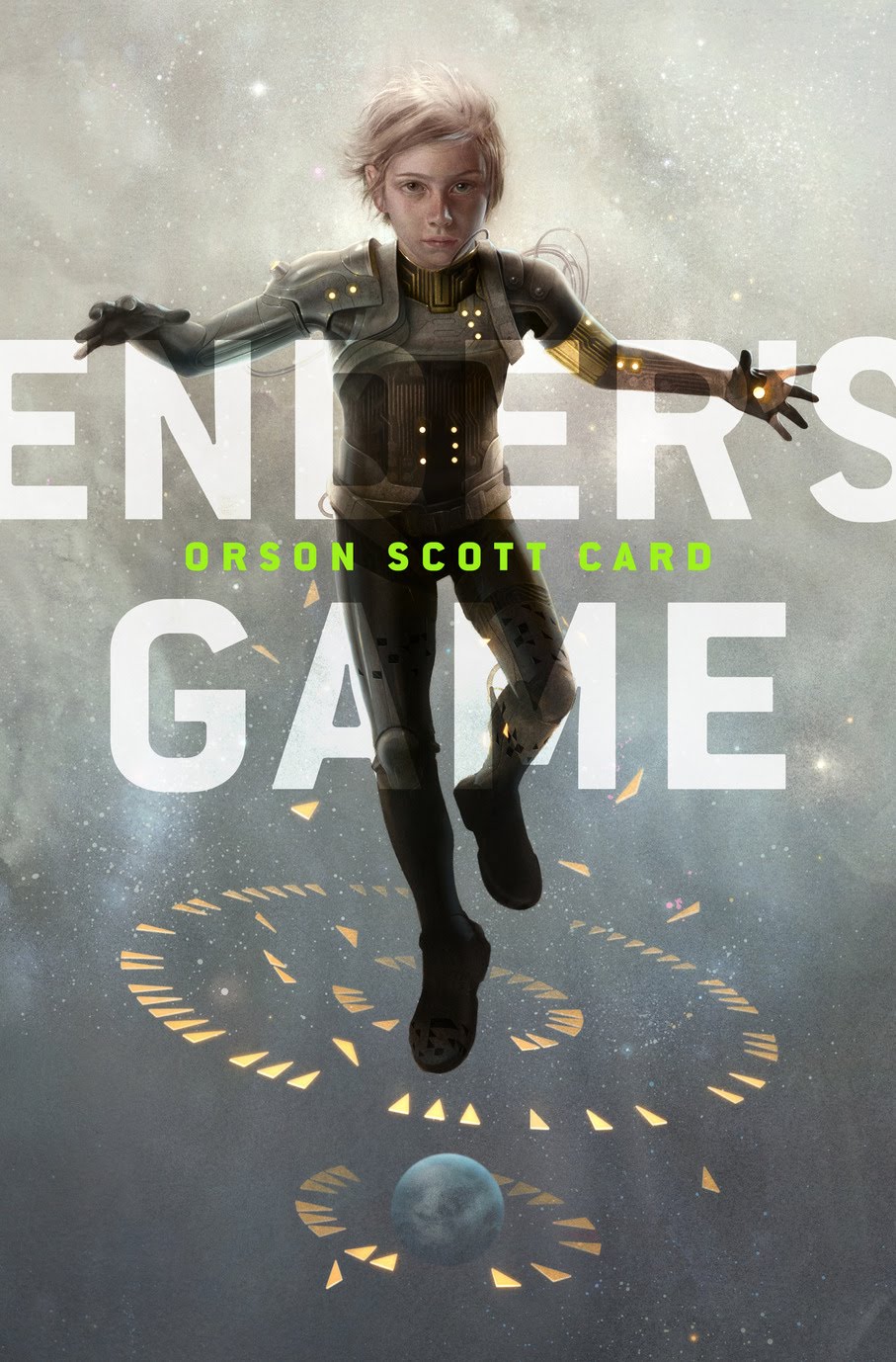
Can a Story Change Your Life? - Ender's Game, by Orson Scott Card


If I had to identify the book that exerted the greatest influence on my decision to become a fiction writer, it would have to be Orson Scott Card's Ender's GameMuch like Alfred Slote's C.O.L.A.R., from last week's Can-a-Story-Change-Your-Life? (or CASCYL for short . . . sounds like "castle?") post, it hit several of my personal interest points:  child geniuses, strategy games, interstellar warfare, and the philosophy of war.  But what gave it such a profound and lasting impact was how it took those elements and interwove them into a deeply compelling story that centered, more than any story I'd come across before it, on character, and really getting you inside his head. 
The science fiction elements, though robust and well-realized on their own, in truth served primarily as tools to allow the reader to delve deeper into the protagonist's mind.  Much like the monitor device introduced in the novel's opening pages allowed Ender's observers to gain a thorough enough understanding of him to make him the linchpin of their war plans, the course of the novel makes the reader so invested in Ender that the wonderfully orchestrated climax scores a direct emotional impact. The reader experiences precisely the same reaction that he does in rippling waves of exhilaration, disbelief, and latent horror - the very essence of catharsis. 

The ironic - perhaps even tragic - truth that Ender comes to realize of his various enemies in the novel resonates with the truth that the reader comes to realize of him:  just as his understanding of them grows to the point where he both comes to love and destroy them in the same bittersweet stroke, the reader's understanding of Ender grows to the point where the reader comes to love him even as he undertakes the very actions that profoundly alter - and, in that way, destroy - the very person the reader has come to know.  Although Ender endures the novel's events, he is, like the mono-mythic hero, changed by the experience, and the boy that the reader has come to know in the course of the novel is lost forever.  The fulfillment of understanding concurs with the echoing ache of that bereavement, and the resulting amalgam of emotion and reason far exceeds the sum of its parts.

This kind of deeply personal connection with story and character is, I think, only possible in the fixed media realm (sorry, film, TV, and anime):  specifically, novels and - I would contend - graphic novels.  Those forms reliance upon written word - which is admittedly on a sliding scale when it comes to graphic novels - are what allow for the in-depth introspection that enables the kinds of character studies that allow you to experience another person's life as your own.  This contention makes me view the upcoming Ender's Game movie with a certain degree of trepidation; divested of the advantages provided by the novel medium and OSC's direct storytelling prowess, will the silver screened story hold up to its written counterpart?  Will what it gains in immediacy of action and bombast of visual and auditory effect make up for what it loses in interior thought and reflection?  The storyteller in my suspects not; the eternal optimist hopes it will.


Monday, May 6, 2013

Can a Story Change Your Life? - C.O.L.A.R., by Alfred Slote


As I'd planned on approaching this series chronologically, I began this entry by searching as far back in my memory as I could for first story that gripped me long after I'd read it cover to cover and had set it aside.  It may be that I'm forgetting something that came earlier - something that influenced me so subtlety and formatively that I can't even remember it - but when I searched for the earliest story that should feature in this series, Alfred Slote's C.O.L.A.R.: A Tale of Outer Space (1981) immediately sprang to mind.

In fiction market parlance, C.O.L.A.R. is a chapter book:  shorter than a novel and embellished with full-page illustrations interspersed between the prose.  As might be guessed from any title containing a punctuated acronym - especially one from the 1980s - it's science fiction.  As the middle book in Slote's "Robot Buddy" series (inaugurated with My Robot Buddy in 1975), C.O.L.A.R. predictably centers around a secret colony of androids which is happened upon by the Jameson family, including the viewpoint character Jack Jameson and his robot-buddy-turned-brother Danny.  The tensions arising from this inciting incident are predictable - but in a story intended for 6-12 year olds, this is perhaps more of a virtue than a vice - and well-positioned to test the core relationship between Jack and Danny that underlies Slote's entire series.

Although I would defend C.O.L.A.R. as a fine example of what a chapter book should strive to be, it would be a stretch to say that so simple and straightforward a story should have the inherent potency to make a person better simply for having read it.  Instead, its place in this series is earned not by its intrinsic attributes, but rather by its effect on the reader - in this case, me.

Even in grade school, I craved stories about human-like robots and androids.  I suppose those tropes more than any other were why I naturally gravitated to science fiction as a genre.  But at least at my school and local libraries, stories featuring androids aimed at a younger audience were very hard to come by.  Finding C.O.L.A.R. - which I found before My Robot Buddy or the other books of the series - opened my eyes to the possibilities, and gave the first satisfying scratch to an itch I, until that point, hadn't fully realized that I had.  At least part of the impulse that led me to begin writing stories of my own were rooted in the fact that there weren't enough stories already out there that fit my personal list of top-tier criteria.

But beyond checking off so many boxes from my list of favorite tropes, I think what made C.O.L.A.R. resonate so deeply might have been its optimistic take on a question that has dominated the robot trope in science fiction:  When humanity makes machines in its own image, how will it treat the darlings of its genius?  And how then will our creations regard us, its creators?  The trope of robots who rise up against their creators is a staple of science fiction, and C.O.L.A.R. taps into that tradition.  Yet it subverts it by strengthening the notion of those robots as humanity's children - the robots of C.O.L.A.R. are actually made to look like and act like human children - and proposing that, as with real children, both nature (or design) and nurture (experience) have a role to play in what they become.  Those heralding an inevitable robot apocalypse might disagree, but I've long anticipated that the more perfected our creations become, the more they will be predisposed to resemble their creators, faults and all.  The question, then, is whether we as a whole will cast ourselves in a positive or negative light.  If, as I suspect, that our good outweighs the bad, the same balance will be struck in those who come into being from us - biological, technological, or otherwise.


Wednesday, May 1, 2013

Illustrating Resource: Wacom イラストレーター Live Painting YouTube Videos


Today's resource post highlights a playlist of "live painting" videos that Wacom has posted to YouTube using its "wacomcl" user account. These 30+ videos, each speed up several times to condense hours worth of work into minutes worth of video, show several well-known Japanese anime-style artists creating illustrations from sketch to finished piece using a Cintiq monitor (which would be Wacom's pecuniary interest in making these videos).  The real value in watching these videos is the unique insight they can give into the work processes of the individual artists, and how much variety in approach and technique exists among them - points of differentiation that contribute directly to each artist's distinctive style. 

On an even more basic level, it can reassure an aspiring artist to see that even professionals whose work appears on book and game covers and even large advertisements in Japan draw their amazing illustrations one line at a time, and even resort to erasing when the lines they've laid down aren't quite working.  In this way, these videos have a similar benefit to those posted by Brandon Sanderson:  they offer a peek at the actual act of creation for artistic works that, when viewed solely as a finished piece, seem superhuman in achievement.  Witnessing these creators do what they do to realize their works is both awe-inspiring - the skill and aesthetic eye involved is apparent even at break-neck speeds - and encouraging.

Monday, April 22, 2013

Can a Story Change Your Life? - Series Introduction


Is there a kind of story so good - so well executed, so resoundingly right and true - that it makes you a better person for having encountered it?  I think there is.  And I believe that anyone who's ever aspired to become a storyteller - whether as a writer, illustrator, director, or other creator - can attribute that ambition to at least one such story.  A story that bowls you over, that makes you stop and take renewed stock of your life and the world around you.  A story that forces you to reevaluate your goals and outlook.

A story's poignancy isn't determined by its own merits alone.  To work properly, a story has to open up a line of communication between its author and its audience - a kind of one-way dialogue made up entirely of action-and-reaction - the results of which rests most heavily on the audience's reaction.  In order for a story to have the kind of impact that can alter a person's life, it has to resound in the specific ways and areas that resonate with the fixtures of a person's values and beliefs.  That a story crafted by one isolated individual could achieve such a resonance with another person across time and space is itself a minor miracle.  That also means that a story that inspires and impacts one person might not reach another - at least not to the same extent.  A story's effect on an audience member falls on a continuum, and no confluence of author-story-and-audience ever falls on the exact same spot.

This dampens somewhat the usefulness of pointing out specific examples that have made an impact on me.  There's no guarantee that what I've found to be poignant and influential will have the same effect on anyone else.  But I think illustration by example may be the most accessible way to demonstrate how this miraculous conflux of entities - which is, I think, the ultimate goal of any storyteller worth his or her salt - can occur.

Accordingly, this series of posts will introduce the stories that have made this sort of lasting impact on me, and the path that has led me to where I am today.


Monday, April 15, 2013

The Link Between Resume Writing and Fiction Writing

Good writing centers on effective communication.  The central paradox of any work of art - whether a book, a painting, a sculpture, or a motion picture - is that it brings together the minds of its creator and the minds of its audience - sometimes so closely or profoundly that the former influences the latter in a life-altering way - even though the two parties may never meet.  More purpose-driven writing such as memoranda, reports, essays, and even resumes and curricula vitae also hinge on the clear conveyance of the writer's expression - his or her core message - but through avenues that, when successful, lead to direct interaction with intended audiences:  in a resume's case, the job interview.

So what message must a resume convey to secure a spot at the interview table?  The answer depends on another question:  who exactly is the interviewer looking for?  Or, more precisely, what qualities does he or she value above all others for the specific role to be filled?

It boils down to knowing the audience and their expectations.  Just as you'd want to read science fiction or fantasy to be familiar enough with the genre's tropes to know how to use them - and when to break them - before writing professionally for science fiction or fantasy markets, you need to gauge what the employer is looking for in their expected hire, and tailor your resume to match those expectations as closely as possible.

The first step is scrutinizing the job posting.  What will the new hire be responsible for?  What do the education or experience requirements say about the qualities or skills that the employer wants to see?  To what extent can your own experiences and abilities match up with what they're looking for?

At this stage in the process, it may also be wise to consider how closely the job description matches what you're looking for yourself.  If the divide between the lines on your resume and the job description is wide, will you be comfortable bridging that gap if the employer chose you for the job? 


Monday, April 1, 2013

Tools of the Trade: Sketchbooks

In my initial drafts, setting and description often take a back seat to character, action, and dialogue.  Milieu details, therefore, often occupy a prominent spot on my redrafting checklist.  Sometimes you can work out the placement of a scene in your head.  But sometimes the arrangement of a scene requires mapping out to get it just right.  That's where today's Tool of the Trade comes in:  the sketchbook.

Three of my favorite sketchbooks:  Two 9" x 12" Cansons and a B5  Deleter sketchbook mini.

The usefulness of a conducive piece of paper - sized according to your specific needs - comes into play especially when you're dealing with fantastic or sf elements that simply don't exist in the real world.  Case in point:  a short story I've been working on that takes place on an O'Neill-cylinder-style space station.  The climax, which once took place in a deserted industrial district - just like any you'd find on a planet - has moved to a observation "ring" that overlooks the cylinder's interior:


A bare-bones line sketch viewpoint shot of the observation "ring" - which  might eventually be fleshed out into concept art.

I found I couldn't wrap my head around the arrangement and logistics of the climax without drawing out some references first.  In more terrestrial situations, even an overhead two-dimensional map could go a long way to sorting out venues.  In Characters and Viewpoint, Orson Scott Card revealed that the entire premise of Hart's Hope came from a gate-dominated city map he doodled one day.

The more I've worked on my writing and drawing techniques, the more I've found that each sphere of creation resonates with one another; that lessons of technique from one strangely reinforce and point toward lessons in the other.  If nothing else, the deeper you delve into either craft, the more you realize you have left to learn.

Monday, March 25, 2013

Writing Resource: WriteAboutDragons's Brandon Sanderson Lectures


Since his first publication in 2005, Brandon Sanderson has become one of the standout fantasy writers of the 21st century, with bestselling stories of his own - notably the Mistborn trilogy and ongoing Stormlight Archive series - and his role in concluding Robert Jordan's Wheel of Time series.  But beyond his prolific career and worldbuilding prowess, he is also notable as one of the most accessible and open writers in recent memory with regard to his own writing process, and in his ability to share what he has learned with others.  In many ways, his decision to teach the same creative writing course at BYU that he himself took as an undergraduate influenced my resolution to teach several legal writing courses at my alma mater law school - the very same courses that I took as a law student several years ago.

One of the most rewarding aspects of teaching is how the process of teaching others forces you to reexamine your own methods and perceptions, often resulting in new flashes of insight and understanding that not only help you to share what you've learned with others, but also offers a deeper comprehension of the processes underlying your writing, inevitably improving upon it.  Watching Brandon's BYU lectures not only gives you a closer look at the mechanics and practicalities of fiction writing, but also a model of how an expert in a field can effectively share his hard-won knowledge and understanding with others.

This series of 2012 lectures is made available through WriteAboutDragons, which is run by Scott Ashton, a former student of Brandon's who wanted to share the "vast quantities of pure gold that issued forth from Brandon's lips every time he opened his mouth."  Scott will also be sharing lectures from Brandon's 2013 course, with the first video due on June 1st.

Monday, March 18, 2013

Why It's Never Too Late to Start: Retroactive Posts Announcement


Like many others out there, I started this year with a resolution.

And like most of them, I broke it within a week.  (Or a month, depending on how you count it.)

The goal was to update this blog with consistent updates - at least one a month.  What got in the way was a combination of work and after-work - the latter mainly taking the form of teaching at my local law school.  Bottom line is that I got so busy that blogging - and even fiction writing - took a back seat to everything else I had going on, until that monthly milestone had passed me by.

Twice.

Technically, that new year's resolution is broken and gone.  Perhaps the usual response would be, "Oh well, better luck next year."

But I don't want to wait until next year.  I want to get back to where Fictional Matters should be, where it would have been had I managed to update it as I had meant to.

So in addition to updating every week from here on out, I'm going to be instituting a "retroactive posting" project.  That means I'll be adding retroactive posts - one for each week I've missed since January 7th - until I've closed the gap.  It won't unbreak my New Year's resolution, but it'll get FM to where it should be.

It also demonstrates how it's never too late to start working on something you've been meaning to do for a while, regardless of what may have held you back.  The moment you set your mind to it, commit to a plan, and stick to it, is the moment that the false starts no longer matter.  What matters is that you've started.


Monday, March 11, 2013

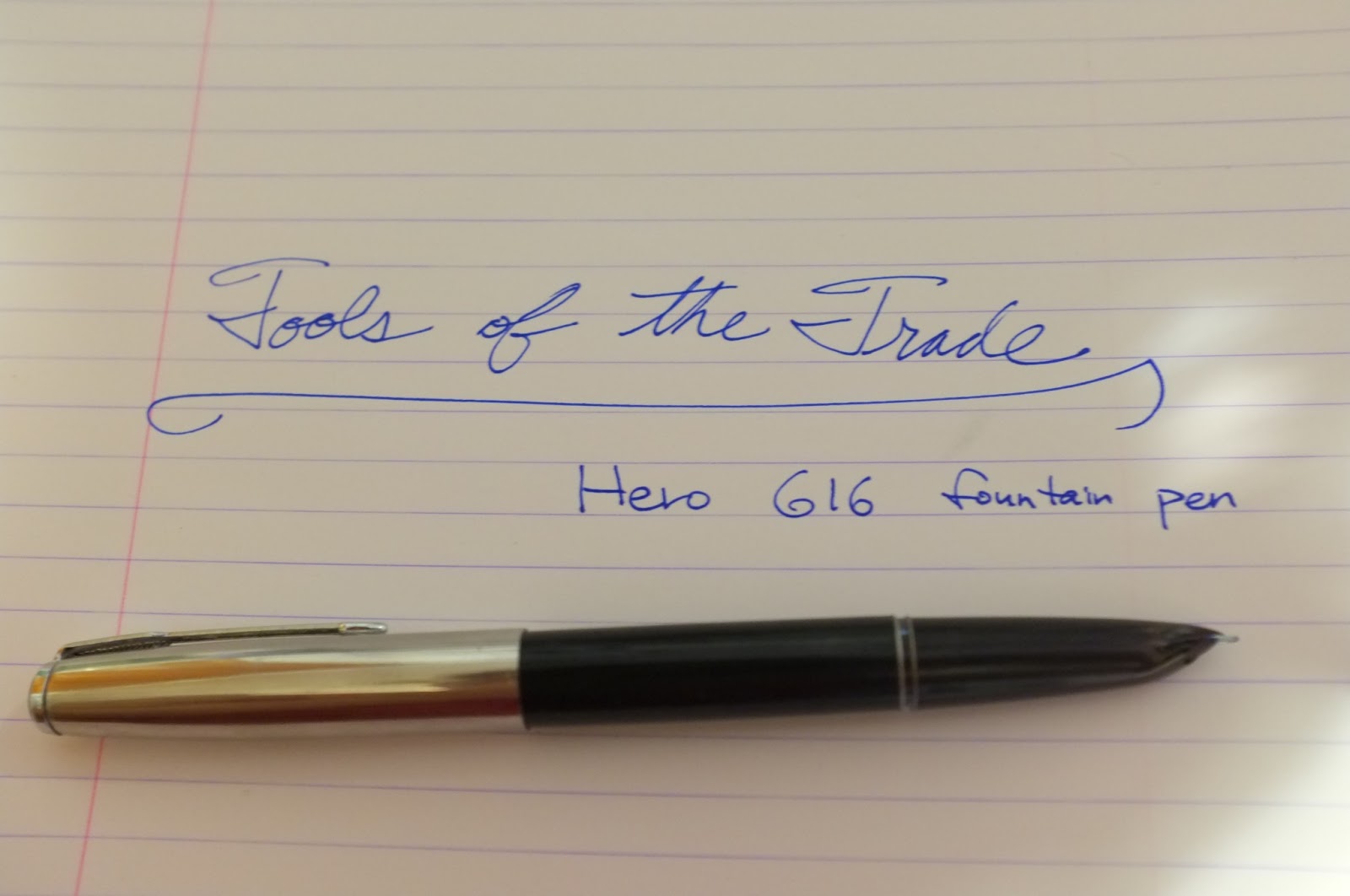
Tools of the Trade: Hero 616 Fountain Pen


Fountain pens have been a lifelong obsession of mine since I first laid hands on a disposable Pilot Varsity over twenty years ago.  The one regret I had from the written portion of my bar exam several years ago was that I was forced to use a heavy-handed ballpoint to write out my answers.  How the examiners managed to decipher my chicken-scratch handwriting well enough to give me a pass remains a mystery to this day.  (Interestingly enough, the very next administration of the exam was the first to allow examinees to type out their essays on a computer loaded with ExamSoft.  Coincidence?  Who knows.)

I've used fountain pens whenever practicable ever since then.  (The usual impracticability occurring wherever carbonless copy paper is used, such as check writing and certain old-school governmental forms.  While a fountain pen could be used in those applications if you exert enough force, I have ballpoints in reserve to save my nibs - and hand - from the unnecessary torture.)   At one point my collection approached a dozen, but like the recent trend with my watch collecting, I've been putting into practice the principle "less is more."  So the Hero 616 is the first fountain pen I've added to the stable in well over two years.  A well-regarded Chinese-made Parker 51 doppelganger, it has several attractive attributes.

The first thing that makes the Hero 616 such an easy addition is its price.  It's readily available on eBay for somewhere between $4-6, shipping often included.  By comparison, the Lamy Safari - commonly regarded as a strong entry-level pen among European models - costs around $20.  The Hero 616 really won't break the bank, and offers solid performance that amounts to a high value-to-cost ratio.  Its affordability also means that you don't have to baby it the way you might a pricier pen costing several hundred (or more) dollars.

That last attribute is the main reason I picked one up:  I've been looking for a good home for my long-neglected bottle of Noodler's Baystate Blue ink.  Baystate Blue is notorious in FP circles for being finicky in use, staining barrels and even laying waste to pen feeds.  Needless to say, it's not the ink you'd want to use in a delicate vintage or exorbitantly priced pen.  So why bother with it at all?  Its vibrant shade of blue brooks no comparison.

The Hero 616 has a reputation as a solid platform for Baystate Blue, and my experience corroborates it.  I've had Baystate Blue clog up a Pilot Prera and Lamy 2000 in the past after only a day or two of disuse.  The Hero 616 is still going strong three weeks down the line.

Monday, February 25, 2013

Writing Resource: Brandon Sanderson's YouTube: Writing Videos


Brandon Sanderson has done for the YouTube age what Harlan Ellison did when he wrote an entire short story in the display window of a department store:  put the usually private act of fiction writing out there for the whole world to spectate.  Through his YouTube channel, in a series of videos that receives an update every week, he is sharing his process in writing an interlude scene from the upcoming second book of The Stormlight Archive series.

I for one have always wanted to peak over the shoulder of a published (and prolific) author to see how they do what so many try to do, but rarely succeed in doing so well.  Brandon makes that wish come true, and the answer is both reassuring and humbling at the same time:  they write their books the same way every person on the planet writes: one letter at a time.  There's no magic method at work here; just hard, consistent work and skill earned from experience.