Monday, March 25, 2013

Writing Resource: WriteAboutDragons's Brandon Sanderson Lectures


Since his first publication in 2005, Brandon Sanderson has become one of the standout fantasy writers of the 21st century, with bestselling stories of his own - notably the Mistborn trilogy and ongoing Stormlight Archive series - and his role in concluding Robert Jordan's Wheel of Time series.  But beyond his prolific career and worldbuilding prowess, he is also notable as one of the most accessible and open writers in recent memory with regard to his own writing process, and in his ability to share what he has learned with others.  In many ways, his decision to teach the same creative writing course at BYU that he himself took as an undergraduate influenced my resolution to teach several legal writing courses at my alma mater law school - the very same courses that I took as a law student several years ago.

One of the most rewarding aspects of teaching is how the process of teaching others forces you to reexamine your own methods and perceptions, often resulting in new flashes of insight and understanding that not only help you to share what you've learned with others, but also offers a deeper comprehension of the processes underlying your writing, inevitably improving upon it.  Watching Brandon's BYU lectures not only gives you a closer look at the mechanics and practicalities of fiction writing, but also a model of how an expert in a field can effectively share his hard-won knowledge and understanding with others.

This series of 2012 lectures is made available through WriteAboutDragons, which is run by Scott Ashton, a former student of Brandon's who wanted to share the "vast quantities of pure gold that issued forth from Brandon's lips every time he opened his mouth."  Scott will also be sharing lectures from Brandon's 2013 course, with the first video due on June 1st.

Monday, March 18, 2013

Why It's Never Too Late to Start: Retroactive Posts Announcement


Like many others out there, I started this year with a resolution.

And like most of them, I broke it within a week.  (Or a month, depending on how you count it.)

The goal was to update this blog with consistent updates - at least one a month.  What got in the way was a combination of work and after-work - the latter mainly taking the form of teaching at my local law school.  Bottom line is that I got so busy that blogging - and even fiction writing - took a back seat to everything else I had going on, until that monthly milestone had passed me by.

Twice.

Technically, that new year's resolution is broken and gone.  Perhaps the usual response would be, "Oh well, better luck next year."

But I don't want to wait until next year.  I want to get back to where Fictional Matters should be, where it would have been had I managed to update it as I had meant to.

So in addition to updating every week from here on out, I'm going to be instituting a "retroactive posting" project.  That means I'll be adding retroactive posts - one for each week I've missed since January 7th - until I've closed the gap.  It won't unbreak my New Year's resolution, but it'll get FM to where it should be.

It also demonstrates how it's never too late to start working on something you've been meaning to do for a while, regardless of what may have held you back.  The moment you set your mind to it, commit to a plan, and stick to it, is the moment that the false starts no longer matter.  What matters is that you've started.


Monday, March 11, 2013

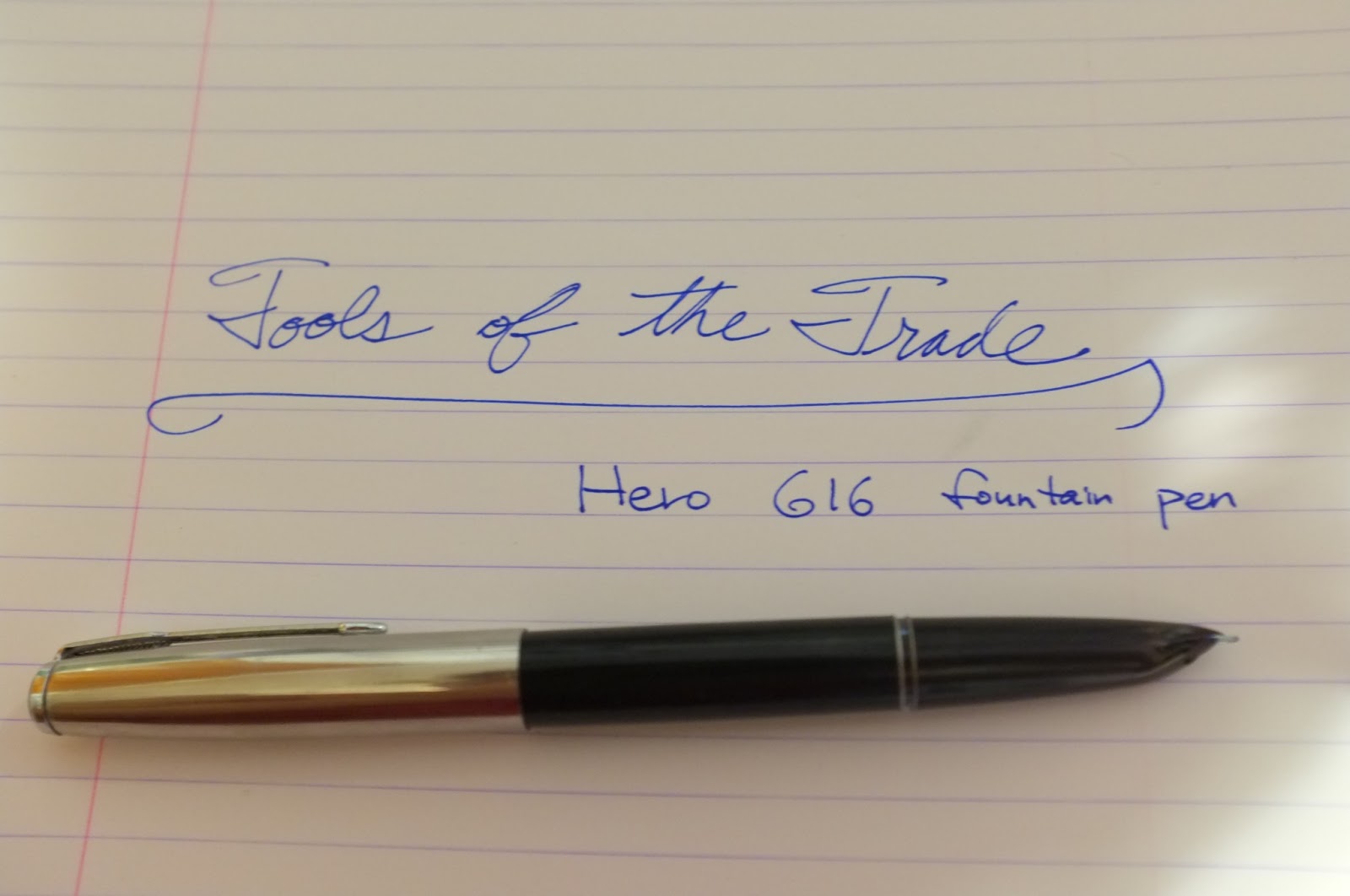
Tools of the Trade: Hero 616 Fountain Pen


Fountain pens have been a lifelong obsession of mine since I first laid hands on a disposable Pilot Varsity over twenty years ago.  The one regret I had from the written portion of my bar exam several years ago was that I was forced to use a heavy-handed ballpoint to write out my answers.  How the examiners managed to decipher my chicken-scratch handwriting well enough to give me a pass remains a mystery to this day.  (Interestingly enough, the very next administration of the exam was the first to allow examinees to type out their essays on a computer loaded with ExamSoft.  Coincidence?  Who knows.)

I've used fountain pens whenever practicable ever since then.  (The usual impracticability occurring wherever carbonless copy paper is used, such as check writing and certain old-school governmental forms.  While a fountain pen could be used in those applications if you exert enough force, I have ballpoints in reserve to save my nibs - and hand - from the unnecessary torture.)   At one point my collection approached a dozen, but like the recent trend with my watch collecting, I've been putting into practice the principle "less is more."  So the Hero 616 is the first fountain pen I've added to the stable in well over two years.  A well-regarded Chinese-made Parker 51 doppelganger, it has several attractive attributes.

The first thing that makes the Hero 616 such an easy addition is its price.  It's readily available on eBay for somewhere between $4-6, shipping often included.  By comparison, the Lamy Safari - commonly regarded as a strong entry-level pen among European models - costs around $20.  The Hero 616 really won't break the bank, and offers solid performance that amounts to a high value-to-cost ratio.  Its affordability also means that you don't have to baby it the way you might a pricier pen costing several hundred (or more) dollars.

That last attribute is the main reason I picked one up:  I've been looking for a good home for my long-neglected bottle of Noodler's Baystate Blue ink.  Baystate Blue is notorious in FP circles for being finicky in use, staining barrels and even laying waste to pen feeds.  Needless to say, it's not the ink you'd want to use in a delicate vintage or exorbitantly priced pen.  So why bother with it at all?  Its vibrant shade of blue brooks no comparison.

The Hero 616 has a reputation as a solid platform for Baystate Blue, and my experience corroborates it.  I've had Baystate Blue clog up a Pilot Prera and Lamy 2000 in the past after only a day or two of disuse.  The Hero 616 is still going strong three weeks down the line.

Monday, February 25, 2013

Writing Resource: Brandon Sanderson's YouTube: Writing Videos


Brandon Sanderson has done for the YouTube age what Harlan Ellison did when he wrote an entire short story in the display window of a department store:  put the usually private act of fiction writing out there for the whole world to spectate.  Through his YouTube channel, in a series of videos that receives an update every week, he is sharing his process in writing an interlude scene from the upcoming second book of The Stormlight Archive series.

I for one have always wanted to peak over the shoulder of a published (and prolific) author to see how they do what so many try to do, but rarely succeed in doing so well.  Brandon makes that wish come true, and the answer is both reassuring and humbling at the same time:  they write their books the same way every person on the planet writes: one letter at a time.  There's no magic method at work here; just hard, consistent work and skill earned from experience.

Friday, January 18, 2013

Anime Retrospective Review: Legend of Galactic Heroes (part 1)

Last week's bottomless linking at TVTropes.org brought Legend of Galactic Heroes back on my radar.  I'm certain I came across LoGH before, but was deterred from looking into it due to its age (beginning in the mid 1980s), voluminousness (a 110-episode primary OVA series, several movies and smaller side-story OVAs), and commercial unavailability in the U.S.  But due to the dedicated effort of fansubbers, the entire franchise is available online.

Discovering LoGH in 2013 is an intriguing experience.  It is the kind of classic, sweeping space opera that has become an increasingly rarefied - or, if present, in increasingly diluted form - in popular media. This grandiosity is, for modern audiences weaned on the CGI whiz-bangery of more recent sci-fi anime series or even the more realistic (excepting sound in space) re-imagined Battlestar Galactica, juxtaposed with the hand-drawn space fleet battles, with the obvious technical limitations that format imposes on the art direction.    But it is the ensemble cast of dozens of interesting and diverse characters, I think, that imbues the series with enduring timelessness.

Monday, January 7, 2013

TVTropes.org: Addictive Time Sink or Author's Resource?

In the years since Wikipedia soundly replaced the Encyclopedia Britannica as the world's go-to reference resource (or perhaps it merely shares that role with Google?), I don't think there's an internet literate person alive who hasn't lost an afternoon to its bottomless links: entries that link to other entries that link to other entries, ad infinium, each offering another tender morsel of trivial information that is just tangentially related enough to your original search term to be of interest.  This sort of linking by relationship is the way in which we store and categorize information intuitively, so it should perhaps come as no surprise that reading wiki entries in this manner should be so appealing - and often times downright addictive.  I'll readily admit to losing several hours at a span to bottomless linking - though I inevitably emerged from the experience well edified in some facet of minutiae.

TVTropes.org could be quickly labeled a Wikipedia for the creative media obsessed, and such a label wouldn't be entirely wrong.  The bottomless linking is, if anything, even more pervasive and potentially addictive, as the premise of TVTropes is to identify and flag the various "tropes" - referring not so much to turns of phrase as to the fictive archetypes that can be repetitively found in narrative works.  Those tropes form the core structure of the wiki, although specific creative works, if popular enough, also often have a page of their own listing the tropes that they employ.  The result makes ping ponging between tropes, works, and everything in between (some well-known actors/creators have their own TVTropes page) ridiculously easy . . . and maddeningly addictive.

I burned through much of the weekend jumping from page to page on TVTropes, performing a RAM balancing act with my browser, the tabs of which tend to expand exponentially while you're jumping from link to link.  Although my initial reaction to realizing how much time I'd sunk into it was dismay and a profound sense of waste - admittedly, both being my default reaction to anything not creative (and, on off days, toward the creative process too!) - I think there may be something worthwhile to the exercise. 

One important step in becoming an effective creator is to familiarize yourself with the genre(s) in which you want to create.  Stephen King and Orson Scott Card have urged would-be authors to read voraciously, even (and sometimes especially) outside the confines of genre.  One rationale is that only by exposure to other works can you hope to identify (and avoid) the stereotypes that would get your work dismissed out of hand by readers.  Another is that you can't hope to bowl over another person with the power of your words until someone else has done it to you. 

To a certain extent, then, TVTropes is like a crib sheet of all the stereotypes in the creative world.  But, as one of the most linked pages will tell you, Tropes are Just Tools, devoid of intrinsic goodness or badness.  It's the one who uses them - the creator - who imbues a value of goodness or badness in their use, depending on how and where it is executed.  To a certain extent - and like stereotypes - tropes as used in TVTropes are necessary building blocks of creation.  They are the narrative touchstones that must inevitably be invoked in order for creators to do what they do.  In that way, they are a manifestation of that old axiom that there is nothing new under the sun.  The unsaid addendum to that axiom is that there are, nonetheless, innumerable new and innovative ways to handle all sun-worn subjects.  This contention underlies TVTropes' entire enterprise, and makes it a worthwhile resource for those seeking to eke out their own space in the creative universe.

Tuesday, January 1, 2013

2013 New Year's Resolution & Site Revival

Seeing as 2012 came and went without seeing my primary fictional project - a science fiction short story - unfinished, I've resolved to devote 2013 to getting that project out the door, along with several others that have been on the backburners for too long.  This blog is one of them.

I started this blog hoping to share some of the things I've learned, having labored in earnest on fictional matters for nearly 15 years.  This endeavor was doomed from the start, for at least two reasons.

First, despite the 15 years I've dabbled in the craft, I'm still a novice.  I have no fictional publications to my name.  I have no formal education in fictional matters outside of minoring in creative writing in college and taking the odd drawing course or two.  While I have uncovered the random pearl of creative wisdom here and there along the way, I'm about as responsible for them as a broken clock is for being right twice every day.  Like the clock, my only prevailing virtue is being here, day after day.

Given that I'm still stumbling around the subject matter myself, taking on the mantle - as I'd originally intended - of an blogging advisor is perhaps a bigger bite than I'm equipped to chew.  This may be why the entries I'd hoped to post on writing tips, strategies, etc. halted so quickly after they started.  Despite my efforts and aspirations, I am at this point worse than than unpublished fiction writer: I'm an unfinished one.  I don't even have a finished draft of anything that I'd even send out to collect an obligatory smattering of rejection letters.

A logical conclusion to this realization might be to pack up Fictional Matters and put it on hiatus - if not for good, than at least until I get a few publications - or, heck, even a truly finished story or two - under my belt. But another of my 2012 milestones was teaching a writing course as an adjunct law school professor, an undertaking for which I was marginally better qualified.  Teaching for the first time showed me that you don't have to be perfect to impart important lessons.  You just have to be willing - and, like the broken clock, you at least have to be there.

The second reason that my initial efforts were doomed from the start is that I have always loathed airing personal details publicly.  This raises an inherent - and some might say irreconcilable - conflict with the blogging manifesto: to put something out there, for the wide open public of the internet to consider as they will.  It also runs contrary to the creative impulse that underlies all fiction: the only way to make something fictitious matter to an audience is to imbue it with enough truth to attain a requisite level of verisimilitude, and, in doing so, achieve a certain degree of catharsis for creator and audience alike.  The only way to do that - as far as I know - is to delve deep into the truths that you find buried within yourself, and draw them out into the light.  To achieve fiction's purpose - whether you're writing a story, painting a picture, or molding a sculpture - you have to reveal some trembling, vulnerable part of yourself for all the world to see, to judge, but above all, to understand.

I think the reason I hate to share personal details is tied to the reason I am an unfinished writer: I want my works to be perfect before the audience lays eyes on them.  I want to be able to polish away the rough edges, to smooth over the cracks before anyone can notice them.  But keeping so much of the process sequestered in this way, bottling it up so that the pressure builds into a terrible and paralyzing inertia, has slowed everything down.  In life, there is no more precious a commodity than time.  But worse than the time wasted in this stasis are the opportunities squandered; specifically, the opportunities to lay out the mistakes of my endeavors and learn from them, but more than that, to make those mistakes and their resulting lessons available for the benefit of others struggling, like me, with the siren-song allure of creation.

And so I welcome the new year with a renewed resolution.  Fictional Matters will see frequent - no less so than monthly - updates that will catalog my efforts, my triumphs (if any), but most importantly of all, my failures.  It will serve as a kind of notebook for my fictional endeavors, laying bare as many steps in my process as I can bear to share.  The end goal will be to spur things on, and hold me accountable to my undertakings, so that when I'm in a position to look back on 2013, I'll be able to list one or two projects that will at least have been finished by then.  And if the steps in that journey can be of help to those brave internet searchers who happen upon this blog, then so much the better.